



My First Home Computer - IMSAI 8080
 In
1975, the magazine Popular Electronics came out with an article about how to
build you own "home computer" based on the Intel 8080 microprocessor, the Altair
8080. This was the real start of the Personal Computer revolution although it
was not until a couple years later when the first IBM PC came out that the term
"Personal Computer" replace the term "home computer". I had subscribed to
Popular Electronics for years and had built several of the projects they had in
their articles (see story) but when I saw the article on the home computer, I
thought it was the neatest thing and read everything I could about it. One of
the student operators that worked for me at CIRCA bought one, assembled it and
showed it to me and I had some reservations about buying one. The next year, in
1976, another company came out with a improved version of the Altair called the
IMSAI 8080 and decided to buy one. I went all out, spending over $2000 to get a
whopping 16K of memory, a ROM board, a cassette interface, parallel interface,
and serial interface. The system came just a couple of weeks before I was going
to move to Melbourne (see story) and so I waited to starting putting it together
until after I moved, man was it hard to wait. As soon as I got settled in my new
place I started putting it together. The entire system came as a kit, down to
each circuit board and chips. The memory boards were the worst to assemble for
at the time there were only 2Kx1 bit memory chips. At the time I thought it
would be best to put all the chips on the circuit boards on sockets so that if
one went bad I could replace it. In the long run this turned out not to be such
In
1975, the magazine Popular Electronics came out with an article about how to
build you own "home computer" based on the Intel 8080 microprocessor, the Altair
8080. This was the real start of the Personal Computer revolution although it
was not until a couple years later when the first IBM PC came out that the term
"Personal Computer" replace the term "home computer". I had subscribed to
Popular Electronics for years and had built several of the projects they had in
their articles (see story) but when I saw the article on the home computer, I
thought it was the neatest thing and read everything I could about it. One of
the student operators that worked for me at CIRCA bought one, assembled it and
showed it to me and I had some reservations about buying one. The next year, in
1976, another company came out with a improved version of the Altair called the
IMSAI 8080 and decided to buy one. I went all out, spending over $2000 to get a
whopping 16K of memory, a ROM board, a cassette interface, parallel interface,
and serial interface. The system came just a couple of weeks before I was going
to move to Melbourne (see story) and so I waited to starting putting it together
until after I moved, man was it hard to wait. As soon as I got settled in my new
place I started putting it together. The entire system came as a kit, down to
each circuit board and chips. The memory boards were the worst to assemble for
at the time there were only 2Kx1 bit memory chips. At the time I thought it
would be best to put all the chips on the circuit boards on sockets so that if
one went bad I could replace it. In the long run this turned out not to be such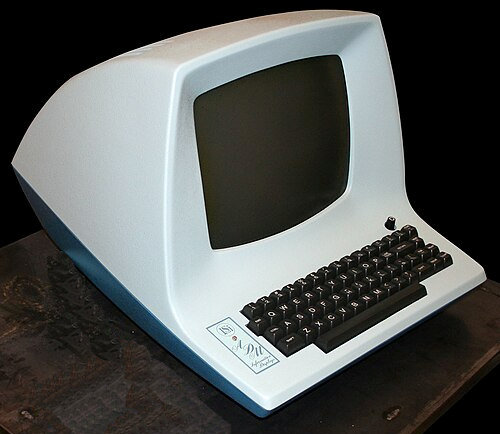 a good idea because there were often problems with bad connections. Sometimes
the system would stop working and I would take out a board and take a rubber
mallet and "reseat" the chips. The only storage was audiocassette. To get the
system going you had to toggle in a small boot program that would then read in a
larger program from the cassette. I bought an
ADM-3A "glass teletype" terminal for
the console. The ADM-3A was quite expensive at $995 (over $5,000 today),
almost as much as the IMSAI computer but it made the computer actually useable.
It was called a "glass teletype" because it replaced the commonly used
Teletype terminal which is what many people used. I also built a computer
table to put the ADM-3A on, see
computer table.
a good idea because there were often problems with bad connections. Sometimes
the system would stop working and I would take out a board and take a rubber
mallet and "reseat" the chips. The only storage was audiocassette. To get the
system going you had to toggle in a small boot program that would then read in a
larger program from the cassette. I bought an
ADM-3A "glass teletype" terminal for
the console. The ADM-3A was quite expensive at $995 (over $5,000 today),
almost as much as the IMSAI computer but it made the computer actually useable.
It was called a "glass teletype" because it replaced the commonly used
Teletype terminal which is what many people used. I also built a computer
table to put the ADM-3A on, see
computer table.
About the only thing it could do was run basic (developed by Bill Gates) and play a few games. I continued to upgrade the system over the next couple of years adding a dual 8-inch floppy disk, 48K of memory and a very early memory mapped video card. With the addition of the floppy disk it actually became a usable system running the CPM operating system and Wordstar for word processing. I had an old used Centronics line printer for printing.
I remember telling Harold Topol who I worked for about my computer and describing it to him. He couldn't see what good it was other than playing with. I told him that in a few years every small business and many homes would have one. I don't think he believed me but when the IBM PC came out in 1981 I think he started to have second thoughts. By 1984 he was doing quite a business installing and developing programs for small businesses in the area using the IBM XT.
I sold my IMSAI 8080 in 1988 in a garage sale for I was moving to Virginia for a new job. Years later I regretted selling it for it was something special.
Updated: 01-11-2026