


The Case of Oceola’s Missing Head
Osceola at the Theatre
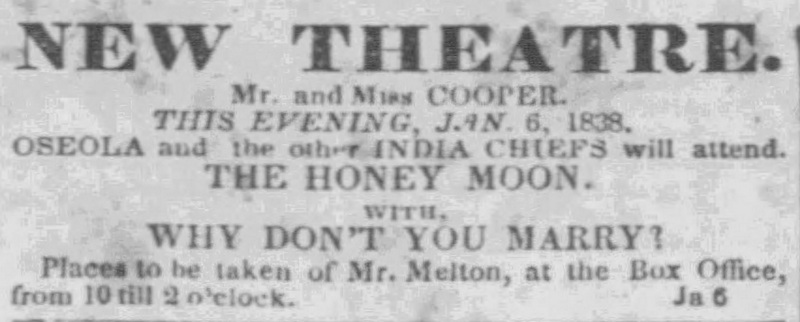
The Charleston Daily Courier, January 6, 1838
While at Fort Moultrie, the Seminoles were given freedom within the enclosure “for the benefit of their health,” and on January 6th the chiefs were taken into Charleston to the “New Theatre” to see the performance of the play “Honey Moon” by John Tobin.
The theatre was packed with every seat taken, many, if not most, had come not to see the play, but to see Osceola, including James Ransom who wrote the following poem about Osceola which was published in the Charleston Daily Courier the next day and then other papers throughout the U.S.
OCEOLA AT THE CHARLESTON THEATRE
By James B. Ransom
The chandeliers sent forth a dazzling light,
And a splendid lamps and paintings shone around,
The scenery was superb, and all looked bright,
While not one vacant seat could there be found.
Indeed, a prince of high pretensions might
Have view the scene, without a single frown-
For beauty, fashion, learning, all combined
To form a crowd, genteel, polite, refined.
Then Oceola, with his warriors came-
A stern, unbending stoic band they were-
Whose names, in truth, will “long be known to fame,”
For deeds of valor, and for love of war.
With ear-rings, trinkets, necklaces and bands,
Head deck’d with feathers, rings upon their hands-
A group so mild, grotesque, and yet so sage,
Have every seldom looked upon the stage.
I mark’d the heavy thought upon his brow,
Which clung like mist around the mountain top,
And watch’d his listless mien and careless bow,
As tho’ he saw the play, but heard it not.
And then his lips would breath some secret vow,
To strike for injuries ne’er to be forgot,
And peril all, tho’ life should be the cost,
To save his native home and country, lost.
The lovely glow of Juliana’s face,
Her smiles and blushes, and the tears she shed,
Her splendid attitude, and native grace,
Were to his war-lit fancy, state and dead.
Yes, there he sat, subdued, but still enraged,
(Like the fierce tiger when he’s caught and caged,
Will like composed-yest when you pass him by,
You’ll see a “lurking devil in his eye.”
The softest strains of music fell unheard,
And every sound seemed lost upon his ear-
While songs that spoke of love in every word,
Nor made him sigh, nor smile, nor drop a tear:
For his wild thoughts, like some unfettered bird,
Flew swift as lighting to that home too dear,
Where’s his undaunted heart still longed to go,
To raise the savage yell, and fight the foe.
Charleston, January 7, 1838
*The play was the Honey-Moon-Juliana[1], by Miss Cooper.
The Charleston Daily Courier, Jan.9, 1838
*Poem later published in Osceola, or, Fact and fiction: a tale of the Seminole War, by James Birchett Ransom, Harper & Brothers, NY, 1838. In the book Ransom says he wrote the poem at the Merchant’s Hotel, Charleston, S.C. on January 7, 1838
The play is set in Spain in the early 17th century with the Duke of Aranza, pretending to be a peasant, tricked Juliana into marriage, takes her to a country cottage where he tries to reform her "proud spirit". When she submits to his will, he reveals his true identity and takes her to his palace. What did Osceola think of the play? I wonder. The play would have been very strange to Osceola and, not speaking English, would have understood little of it. Did he even watch the play, as he sat amongst over a thousand white people who just a few weeks before were his hated enemy.
[1] The Honey Moon is a play by John Tobin. It was influenced by Shakespeare’s Taming of the Shrew and performed throughout the 19th century in which the which a suitor of the character Juliana is rejected and then wooed by her sister Zamora. Miss Cooper is Fanny Cooper the stage name for Frances Charlotte Dalton. The 1200 seat New Theatre opened just the month before in December of 1837 with the play The Honey Moon.