


A Bit of History
Part III
Florida becomes a US Territory

Florida under the Spanish
1821
United States formally took possession of Florida on July 17, 1821 with Andrew Jackson appointed Governor and it was a mess. Many Spanish as well as free and Black Seminoles fled to Cuba. An 1822 map listed only two main towns, St. Augustine and Pensacola. Separated by the Suwannee River, what was East and West Florida under the Spanish became St. Johns and Escambia counties, with a small western most portion annexed to the Orleans and Mississippi Territories. Most of the interior was under control of the Seminoles.

The new territory needed a capital and Pensacola, the former capital of West Florida, was Jackson’s first thought, after all he was familiar with it after capturing it just three years before, so the first session of the Legislative Council of the new Territory met on July 22, 1822 in Pensacola. Members from St. Augustine, the former capital of East Florida, traveled 59 days to Pensacola going around the southern tip of Florida by ship to attend. Although distance was much shorter, travel across land through somewhat hostile Indian territory was not an option. The second session was in held in St. Augustine, and western delegates needed 28 days to travel peninsula to reach St. Augustine. Their shorter travel time was in part due to the northward flow of the Gulf Stream along the east coast of Florida. During the second session, it was decided to hold future meetings at a halfway point. Two appointed commissioners selected Tallahassee as a halfway point which was an interesting choice as it was virtually abandoned after Andrew Jackson burned it to the ground in 1818. In 1824, the third legislative session met there in a crude log building serving as the capital. Andrew Jackson only served as Governor for two months when he resigned on December 31, 1821 in part due to ill health.
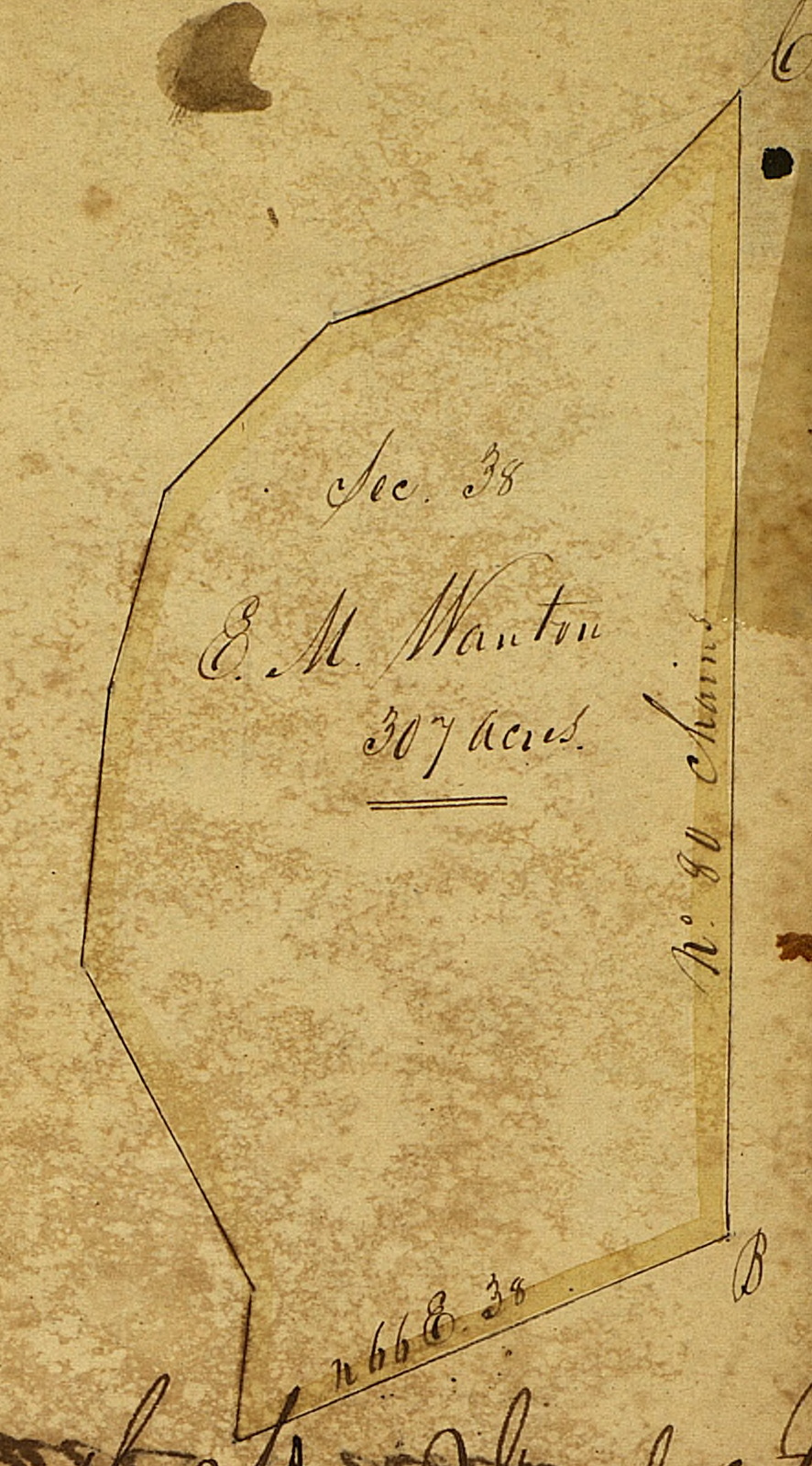
Wanton's Land at Picolata
Click image to see full Deed
One condition of the treaty to transfer Florida to the United States was that the United States would honor all land grants that were made prior to the treaty and that Spain would transfer to the United States all original papers for the grants. While the Spanish officials in St. Augustine did turn over many such documents, some were taken with them to Havana. This would prove to be a problem for some of the grantees. Prior to the ceding of Florida to the United States, a number of influential East Floridians realized that Spain’s tenuous grip on the province was rapidly slipping and to secure their positions under American rule, they rushed to obtain land which was generously obliged by the Spanish Governor. Under United States rule, most of the land grants were not questioned as the conditions of having settled the land were clearly met. One such grant was to Edward Wanton for 307 acres of land on the St. Johns River at Picolata that was the site of an old Spanish fort and strategic crossing point of the river. But other grants were contested as not having met the settlement within three years condition. One highly contested grant was the very desirable and fertile Arredondo Grant. Mr. Worthington, the acting governor of east Florida, wrote in a letter to the Secretary of State in December of 1821, “The Alachua is one of the best bodies of good land-I suppose not less than half a million of acres.” [R#62,p381]
Creating a new settlement was no easy task, taking considerable planning, supplies, transportation, wagons, tools, everything needed to create a settlement in the wilderness, including people, which was not so easy to find. GGrants on or near rivers and the coast had easier access were more easily settled but the Arrendondo Grant deep in the center of Florida in somewhat hostile Indian land was a different story.
Arrendondo engaged Horatio S. Dexter and Edward M. Wanton to negotiate with the Indians to allow Wanton to settle in Arredondo’s grant in Alachua. In return, Arrendondo granted Dexter and Wanton tracks of land within the grant. Dexter and Wanton were not looked favorably upon by Governor Andrew Jackson who considered them “unauthorized” to negotiate with the Indians and ordered Mr. Worthington, “to seize these self made Indian agents, and detain them until the instructions of the Government can be had.” [R#62,p205]
Jackson did not believe that Arredondo even had right to the grant saying in a letter to the Secretary of State, “…will shew that a grant has been made since the 24th January 1818, by the Captain General of Cuba to Arredondo for a large tract in the Alachua plains, and which I have every reason to believe is fraudulent.” [#62,p270]
Fortunately, Dextor and Wanton were never arrested and Wanton’s settlement in Alachua would shape the future of Alachua County.
Part of the Arrendondo Grant agreement between
Arredondo, Dexter and Wanton, February 15, 1821.
University of Florida
Digital Collections
Arrendondo
Grant 1820-1824.

Updated: 06-10-2026