


The Old Country
Treaty of Moultrie Creek
1823
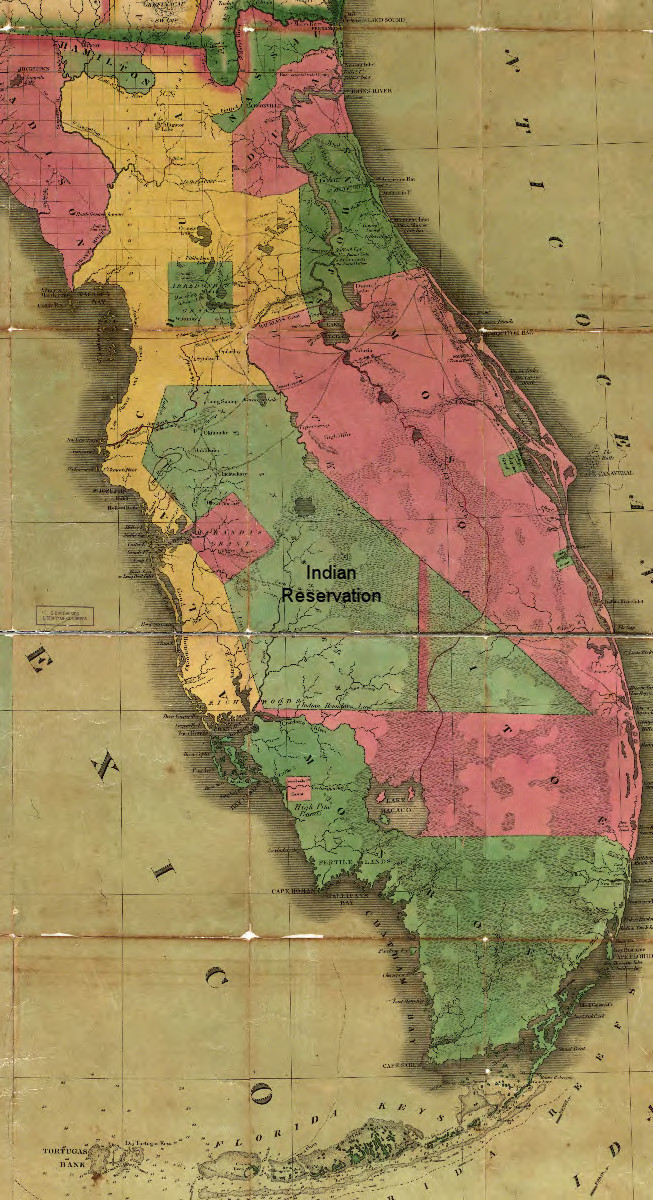
1829 Florida map showing the Indian Reservation and Arrendondo Grant
containing
Micanopy and Wanton’s in Alachua County (yellow) which extended from
the Georgia border southward to Charlotte Harbor.
<Click map for larger view>
Since becoming a U.S. territory in 1821 with Andrew Jackson the first interterm governor there had been the question as what to do with the Native Indians generally referred to as Seminoles although they were a mixture of several tribes. There was talk about moving them somewhere out west, but in 1823 there wasn’t any suitable place in the west, so the next best place was to have them all move to south Florida. After all, it was only the land of the north that the white men wanted for the same reason that the Indians had for thousands of years, it was the most fertile land. Now the land in the south, beginning just south of what is now Ocala, although seemingly large at four million acres, the land was of poor quality with much of it scrub forest which Marjorie Kinnan Rawlings described as, "There is no human habitation—there never has been and probably never will be—in the scrub itself." She called the scrub "a vast wall, keeping out the timid and the alien." In the current day a drive though the Ocala National Forest on highway 19 provides a glimpse of what it was like. Oh, the coasts in the south including Tampa Bay were great, but the Seminoles were not permitted within twenty miles from the coast. All that needed to be done was convince the Indians to move.
The Indians had been uncertain of their fate under the new rule. Several times some chiefs went to St. Augustine to inquire, but learned little. The government said in 1821 that Chief Micanopy of Alachua negotiated a “treaty” for his own people with two white men he trusted, Horatio S. Dexter and Edmund M. Wanton, an arrangement that allowed Wanton to establish his settlement near the Alachua Savana. Andrew Jackson newly appointed governor of the new territory was not a good sign for the natives with one of his first acts was to issue orders to seize these "self made" Indian agents, for no white man had a right to negotiate with the savages except as an authorized agent of the government.[1] Although no action was taken against them and no actual treaty with Dextor and Wanton was ever signed.
On April 17, 1822, William Pope DuVal succeed Jackson as the Governor of the Florida Territory. At first DuVal was sympathetic towards the Indians with many were starving at the time. In July he issued a proclamations about interactions with the and revoked all trading licenses issued to white men before his administration. Wanton at his settlement in Alachua likely wasn’t happy about that as his outpost did considerable trading with the Seminoles including with Chief Micanopy.
Duval appointed Major Gad Humphreys of New York as the official government Indian agent leaving him in charge of negotiations with the Indians. Then in September DuVal suddenly left Florida and went to Kentucky to attend to business he had there. While he was away, November 20th was set for the initial council with the government officials but, at the last hour Humphreys nor anyone from the government showed up and DuVal was out of touch in Kentucky. The Indians showed up at St. Marks finding no government representatives and after three days left annoyed. Governor DuVal returned to Florida in March, 1823, and went about condemning everyone but himself for the confusion which his absence had created.
But DuVal was determined and set the next, well first actually first, meeting to be at Moultrie Creek, about five miles south of St. Augustine. While convenient for the Seminoles in east Florida, include Micanopy in Alachua, the Indians from west Florida would have to travel over 200 miles to get there.
With DuVal’s negotiator ill, DuVal appointed, of all people, Horatio Dexter in his place. The same Dexter who Andrew Jackson had threatened to arrest. It did make sense though as Dexter had been trading and negotiating with the Seminoles since Spanish times. Dexter estimated as many as 1,500 Indians would attend but when the time came only about 425 attended.
Gad Humphres himself escorted a part of 350 Indians of the western Mikasukies and Tallahassee tribes 250 miles to the meeting. The Indians of Florida they were not one cohesive group. There were three major groups, two were called Mikasukies and Tallahassees which were located west of the Suwannee River, and the third were the Seminoles which were east of the Suwannee River. For purposes of negotiation, a head chief was needed so just before reaching Moultrie Creek they chose Neamathla, the head chief of the Mikasukies which DuVal called the most remarkable savage he had ever seen.
On Saturday, September 6th, the first day of the negotiations commenced with the Indians arriving with a white flag raised, beating drums and singing which after the end of every verse issued a shrill hoop followed by a loud collective scream. Upon approaching the white men, two totally naked Indian men painted from head to toe white, with feathers tied to sticks in their hands with made marks on the white men. Neamathla then shook hands with everyone after which Nemathla smoked his pipe then they entered the lodge to begin talks.[2] Seventy chiefs and warriors took part in the meetings. At the start of the meeting, Games Gadsen reminded the Indians that they had been subdued twice by General Jackson and they would not be permitted to be scattered all over Florida. With a heavy hand Gadsen said, "The hatchet is buried; the muskets, the white men's arms, are stacked in peace. Do you wish them to remain so?” After two days Neamathla seemed to accept moving when he said:
We are poor and needy; we do not come here to murmur or complain;... we rely on your justice and humanity; we hope you will not send us south, to a country where neither the hickory nut, the acorn, nor the persimmon grows . . . For me, I am old and poor; too poor to move from my village to the south. I am attached to the spot improved by my own labor, and cannot believe that my friends will drive me from it.
His words about the hickory nut, acorn and persimmons was important as the Indians relied on them for substance and none were found in the proposed land they were to move to in the south. (see map) In addition the reservation was well inland from the coast blocking the Indians from another traditional source of food. On September 18th the chiefs signed the treaty but with an interesting change. Smaller reservations in the Apalachicola River valley in north-west Florida were given to six chiefs including Neamathla, they would not have to move. Thirty-two chiefs signed the treaty. The reservation they were “given” was about 4,032,940 acres, in return they had to give up the rest of Florida, roughly 28,253,820 acres. In return the United States said they would:
- Protect the Indians as long as they obeyed the law.
- Supply them with $6000 worth of agricultural equipment and livestock on the reservation.
- Pay $5000 a year for twenty years. Keep white men out of the reservation except those authorized to be there.
- Provide the natives who had to move with meat, corn, and salt for one year.
- Pay up to $4500 for improvements which the Indians were obligated to abandon.
- Provide up to $2000 for transportation to the reservation.
- Maintain an agent, subagent, and interpreter in the reservation.
- Pay $1000 a year for twenty years to maintain a school on the reservation.
- Pay $1000 a year to maintain a blacksmith and gun- smith on the reservation.
This basically amounted to $221,000 or a cost of .78 cents per acre. Another provision of the treaty was the Gad Humphreys got a one square mile of land although the U.S. Senate thought it improper and removed it before ratifying the treaty.
There was the lingering question if all the Indians agreed to the treaty. Thirty-two signed the treaty including Micanopy. During the talks Neamathla provided a list of thirty-seven chiefs but only seventeen can be clearly identified as signing the document. Few if any of the chiefs could write so there is some thought that the person writing didn’t always correctly record the names. There were also names that were not on Neamathla’s list and it was not clear who they represented.
Other than a few villages along the Apalachicola River, they gave up all claim to lands in Florida including the Arrendondo Grant and were to place themselves under the “protection” of the United States. No white men were allowed to settle, farm or hunt on the reservation as well. Of course, the Indians had no way to stop white men from doing so, and if they did it would have been violation of them being “peaceful and law-abiding”. Indians living in the Apalachicola area resisted moving to the reservation and, even with limited migration, the Indians soon insisted the reservation was not large enough to support them, which even the Florida Governor Duval concurred. A severe drought in 1825 caused food shortages and some starved to death. After continued shortages Governor Duval permitted the Natives to leave the reservation to fish along the Gulf coast. In 1827, even with the limited migration, government funds for the Indians ran out and money was taken from the salaries of the subagent, blacksmith and interpreter for the Indians resulting them all resigning.
By 1834 there was growing discontent among the Indians sparking a new rebellion.
1. Mahon, John K. 1823- “The Treaty of Moultrie Creek, 1823.” The Florida Historical Quarterly, vol. 40, no. 4, 1962, pp. 350–72. JSTOR, http://www.jstor.org/stable/30139875.
2. Glenn, Joshua Nichols. “A Diary of Joshua Nichols Glenn: St. Augustine in 1823.” The Florida Historical Quarterly, vol. 24, no. 2, 1945, pp. 121–61. JSTOR, http://www.jstor.org/stable/30138589.