


A Bit of History
Castillo de San Marcos
(Fort Marion)
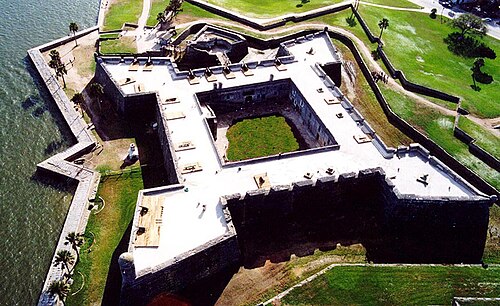
Castillo de San Marcos
(Fort Marion)
The Castillo de San Marcos, in the city of St. Augustine is the oldest stone fort in the continental United States. Built by the Spanish and completed in 1695. Attacked and besieged several times, the fort had never been forcibly occupied however possession changed five times, all peacefully, among four different governments (Spain twice). When Spain ceded Florida to the United States in 1821 the fort became U.S. Army base and renamed Fort Marion. After 251 years of continuous military control, the fort was deactivated in 1933 and became a National Park. In 1842 the original name Castillo de San Marcos was restored by an Act of Congress.
Growing up in Gainesville Florida, our fifth-grade class made a Florida History field trip to St. Augustine, a two-hour bus ride, to see the fort. I remember going into the interior of the fort and seeing the cell which Osceola was held. On the wall next to the cell door was a plaque telling the story, “Here the Seminole Chief Osceola was held.” I’m not sure if it was on the plaque or something we were told was that Osceola starved himself to be thin enough to fit between the prison bars to escape, something I believed until writing this story when I found out that Osceola never escaped. It was true that other Seminoles did escape while Osceola was there and the intention was that Osceola would escape with them, but he was too sick to go with the escapees. Osceola was extremely thin not because he was starving himself but rather because he was sick and would die a few months later.
Castillo de San Marcos is Spanish for St. Mark’s Castle. In 2025 my daughter was visiting me in Gainesville and, wanting something to do together, we made a trip to St. Augustine to meet my sister and her husband, who were camping at Anastasia State Park, for lunch. On the way there my daughter asks, “Can we see the castle,” and I reply, “What castle, there isn’t any castle in St. Augustine that I know of.” She pulls out her phone and does a quick search and says, “Yes there is, it’s called Castillo de San Marcos.” I tell her that’s not a castle, it is a fort. “But Castillo means Castle,” she says. Later as we drove past it, I pointed out that it is a fort, not a castle.