


The Lost City
of
Newnansville
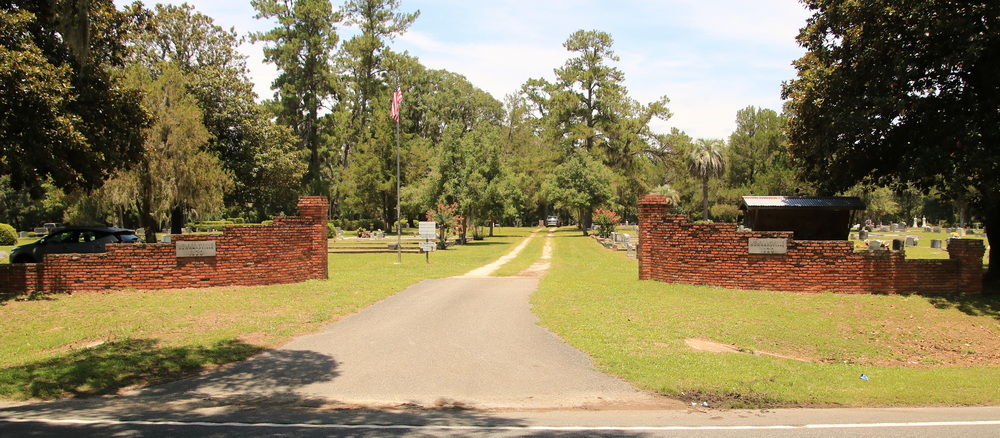
Entrance to Newnansville Cemetery
(my car right parked under tree)
“So where was Newnansville?” I wondered when coming across it while doing research for a story about early Alachua County. Newnansville, a once a thriving town, was nowhere to be found. I was familiar with Newnans Lake lying just east of Gainesville, Dad took my brother and I fishing there when we were boys, but I had never heard of Newnansville. Growing up I aways thought it was “Newmans” lake and wondered what a new man was. It wasn’t until many years later upon returning home to visit my parents did I realize that it was actually “Newnans” Lake. It is a pretty good-sized lake that you can see out the airplane window just before landing at the Gainesville airport. On early maps Newnans Lake had the native Indian name of Pithlachua but was changed to Newnans after a Daniel Newnan who led a detachment of Georgia militia in a battle against the Seminole Indians in the first Seminole war in 1812. Newnansville must also be named after Daniel Newnan I surmised, but where was it located?
Old maps showed Newnansville to be somewhere north of Gainesville but maps of the 1820’s were not all that accurate, and it wasn’t on any modern map. It was at Sunday lunch with family when I got a clue as to its location. For many years our family has been going to the same Baptist church which those attending would often go out to eat together after the services. I haven’t been much of a church goer for many years, but I would sometimes meet those that were for the after-church lunch. It is a nice gathering, a time to catch up on news of the family. Aunts, uncles, brother, sisters, cousins, children, a grandparent or two before they passed, oh wait, my generation are now the grandparents. It was at one of these lunches that I mentioned Newnansville when the wife of my cousin who was seated across from me said that her parents are buried in the Newnansville cemetery which she said was in the present-day town of Alachua where she grew up.
Where there is a cemetery there was usually a town, or at least a community large enough to have a church and associated cemetery. I put Newnansville cemetery into Google maps and sure enough there it was, couple miles north of the present-day city of Alachua, a twenty-minute drive from where I currently live. A road trip was in order.
It was a sunny but hot June afternoon with a mostly blue sky and spotty clouds. I was hoping for an afternoon rain to cool things off, but the regular afternoon summer rains hadn’t started yet. I turned onto Highway 441 heading west towards the town of Alachua which is a scenic drive through gently rolling hills with fields of planted crops and cow pastures with a few business and a new “Tech Center” springing up along the way. Highway 441 used to be a major road until Interstate 75 was built but now it has mostly local traffic or those seeking a more scenic and slower route than the Interstate.
Approaching Alachua, the map app tells me in a female voice with a British accent, “Turn right at the next traffic signal.” I turn right and about a mile out of town I find the Newnansville Cemetery.
“You have reached your destination.” She says in her cute accent as I drive through the pearly gates. No, they weren’t pearly, they were red brick, but when I saw them, it made me think of my grandfather who was a Baptist minister who would preach about the pearly gates of heaven and seeing gates to a cemetery at my age made me think of dying and the pearly gates of heaven. I park in the shade an old oak tree that was perhaps as old as the cemetery, 1820 it said on the red brick gate.
I got out of the car and stepped out of the shade into the sun and find the heat oppressive, ninety-two degrees with ninety-two percent humidity, it had not rain in a couple of days otherwise it would have been 100%. Typical Florida summer day. I’m dressed for it, leather sandals, shorts, a bright pastel green loose fitting Columbia sport shirt that is vented in the back, my head topped with a Panama straw hat complete with a feather I found on some country path with dark sunglasses under its wide brim. I looked right dandy.
Looking around I get the general sense of how the cemetery is laid out. I’m familiar with a number of the cemeteries in the Old Country where my family has been for several generations and, living into my seventies, I have been more than a few funerals. Each cemetery has its own feeling, part from the location and part from the souls that lie within. Newnansville seems nice, past the two large oak trees at the entrance is a large area mostly open, bright and sunny with an occasional palm tree, a central road running down the middle, graves to each side laid out in nice even rows. I set off into the heat and wandered around the graves reading the tombstones. They were all recent, well in the last fifty years or so. I was looking for something older, graves from the time of Newnansville, from the 1820’s and 1830’s. If newer burials were in front the older ones would be in the back, I reasoned as I headed down the central road towards where I expected the older section would be. Continuing down the road I find the dates getting progressively older when I come to a marker...
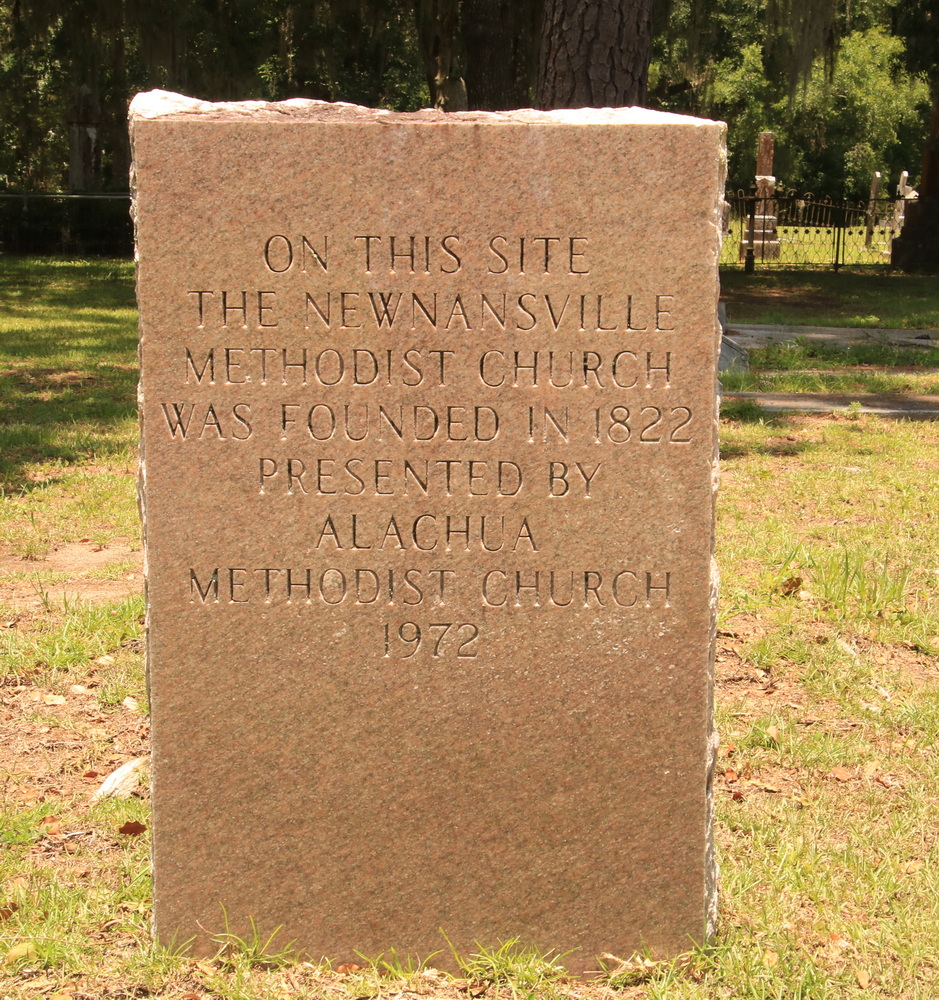
I remember reading an article about Newnansville describing the church….
A Methodist circuit rider who traveled through the wilderness on horseback conducted religious services from time to time. In 1828 Isaac Boring sometimes held service at Dell’s meeting house, with only Dell and his wife present. Although preachers’ lives were lonely and often dangerous, throughout the history of the Methodist circuit riders Newnansville is always mentioned as a place where they preached. Eventually the Methodists constructed a church in the community, on the brow of the hill east of the cemetery.
I was standing in Newnansville.
One of my objectives was to find members of the Dell family, I find a few but not the ones I am looking for, the Dell brothers James, Simeon, and Maxey who first established the town. James Dell established the first post office which was called Dells before it became Newnansville in 1826. I walk around keeping as much as possible in the shade under the oak trees, trees older than those buried under them. The older section is not as well kept as the newer front section, something that often happens when the descendants of those buried there no longer live in the area. Some of the oldest graves are grouped into family plots each with rusted wrought iron fence around it. I entered each and examined the tombstones, many of which were no longer legible. Some of the names I recognize from my research: Pyles, Worthington (Worthington Springs is nearby), Blitch, Stokes among others. The oldest grave in the cemetery belongs to Robert Pyle who died in 1820 at age three. In the older section there are quite a few children that died young, some not having a names, just labeled “Baby Girl” or “Baby Boy”.
I reached the back fence of the cemetery and peering through the trees I could get glimpses of what appeared to be another cemetery beyond but there was no gate or path to it. I had read that all that remained of Newnansville was two cemeteries, this was the second. In older times it went by different names but is now called the “Newnansville African American Cemetery”.
Heading back to my car I see a man holding a clipboard standing next to a pickup truck in the hot sun of newer section of the cemetery talking to two women and think he might be associated with the cemetery, so I head there way. When I get closer, I hear them talking about cemetery plots for their family. I wait patiently and within a few minutes they finish their conversation, and he turns to me and says hello and asks how I’m doing. I tell him, “hot but otherwise quite well” I say then I tell him my name and he responds, “Richard.,” and we shake hands. He is an older gentleman, about six foot in height, mustache, with a complexion you only get from working outside, dressed in well-worn work shoes, jeans, a somewhat worn light cotton shirt and a cap on his head with an emblem of some farm product. He is what I call an “old timer” and thought we should get along well.
I tell him I am doing research for a story about Newnansville and ask him if he was familiar with the cemetery. He says yes and tells me he is a member of the cemetery volunteer’s association. Great! I think and ask him if new of any Dells in the cemetery and he tells me there are and they would in the older section in the back and says, “I can show you if you like.” I say that would be great, and he says, “I’ll meet you back there,” and I say “Okay” as he gets into his truck, starts the engine, and slowly drives towards the old section leaving me standing there in the hot sun. Now it was a good fifty yards of hot sun to get back to the shade of the old section. “He could have asked me to ride in his air-conditioned truck.” I thought as I walked double-time to catch up to him as he was parking under the shade of the trees and was got out of his truck when I approached.
As Richard and I wandered he says “I think there over this way,” as I follow him while telling my interest in the history of Newnansville. Keeping to the shade as much as possible we wander amongst the graves. He says he’s not as familiar with the older area as he was with the newer part. As we headed toward the back, I ask him about what appeared to be another cemetery behind this one and he says it is Black cemetery, it was as old as this one referring to the one we were standing in. He goes on and tells me they used ground penetrating radar a few years ago and found there were over six hundred unmarked graves.
We head back toward the newer graves, passing through periods of time, some Civil War markers, then the early 1900’s. Richard occasionally pauses and mentions something about one family name or another when we a grave which he tells me is his grandparents. We did find the couple Dells that I had already found but no others. We got back to his truck, and he tells me he could search the records for other Dells when he gets home. I tell him I would appreciate that and gave him my business card.
Making the long hot walk back through the newer section to my car I find the graves of my cousin’s wife’s parents. I pause a moment and reflect, I might have met them once, when my cousin got married, but if I did, I didn’t remember them.
Just after lunch one hot June day I get into my all-electric car and head out.