


The Case of Oceola’s Missing Head
Osceola’s Death
Dr. Weedon wrote in his diary the night before Osceola’s death:
“about 4 o’clock Oceola sent for me … asked a favor that his Bones Should permitted to remain in peace and that I should take them To Florida & place them where I Knew they would not be disturbed-here he declared he had done nothing except killing Gen Thompson that he regretted…”
Dr. Fredrick, January 29, 1838
Catlin’s prediction happened sooner than he expected, Osceola at 6:20 p.m. on Tuesday evening, January 30th, 1838 Osceola died.
Death of Oseola[1]
This far famed Chief paid the debt of nature at Sullivan’s Island, on Tuesday night. He had been sick for some time-when we saw him at the theatre, he looked sad and tired of the world. He was attacked with a catarrhal fever, but whether he fell a victim to the common course of this disease, or to the harassments of a vexed and disappointed spirit, is a matter of doubt-probably a combination of the two. He had the best medical attendance and we believe was in nothing neglected-but it would not do—his proud and unconquerable spirit refused to be chained to a captive body. We shall not write his epitaph or his funeral oration, yet is there something in the character of this man not unworthy of the respect of the world. Fram a vagabond child, he became the master spirit of a long and desperate war. He made himself-no man owed less to accident. Bod and decisive in action, deadly but consistent in hatred, dark in revenge, cool, subtle, sagacious in council, he established gradually and surely a resistless ascendancy over his adoptive tribe, by the daring of his deeds, the constancy of his hostility to the whites, and the profound craft of his policy. In council he spoke little-he made the other chiefs his instruments, and what they delivered in public, was the secret suggestion of the invisible master. Such was Osceola, who will be long remembered as the man that with the feeblest means produced the most terrible effects.
The Charleston Mercury, February 1, 1838
A further account of his last moments was provided by Dr Weedon…
About half an hour before he died, he seemed to be sensible that he was dying; and, although he could not speak, he signified by signs that he wished me to send for the chiefs and the officers of the post, who I called in. He made signs to his wives (of whom he had two, and also to fine little children by his side), to go and bring his full dress, which he wore in time of war; which having been bought in, he rose up in his bed, which was on the floor, and put on his shirt, his leggings, and moccasins-girded on his war belt-his bullet pouch and powder-horn, and laid his knife by the side of him on the floor. He then called for his red paint, and his looking-glass, which was held before him, when he deliberately painted one half of his face, his neck, and his throat-his wrists-the backs of his hands, and the handle of his knife, red with vermillion; a custom practice when the irrevocable oath of war and destruction is taken. His knife he then placed in its sheath, under his belt; and he carefully arranged his turban on his head, and this three ostrich plumes that he was in the habit of wearing in it. Being thus prepared in full dress, he laid down a few minutes to recover his strength sufficiently, when he rose up as before, and with most benignant and pleasing smiles, extended his hand to me and to all the officers and chiefs that were around him; and shook hands with us all in dead silence; and also with his wives and his little children; he made a signal for them to lower him down upon his bed, which was done, and he then slowly drew from his war-belt his scalping-knife, which he firmly grasped in his right hand, laying it across the other, on his breast, and in a moment smiled away his last breath, without a struggle or a groan.[2]
So what did Osceola die from? A few days later Dr. Weedon provided the following details:
The Charleston Daily Courier, February 6, 1838, page 2
Death of Oceola.—We have been favored with the following statements of the Physicians in attendance on this distinguished Chief, during the illness which resulted in his death, and insert them in our paper, believing that they will be read with much interest :—
As, no doubt, a curiosity exists in the public mind, to know the causes which led to the death of Osceola, the distinguished Seminole Chief, and as may reports may be circulated on the subject, I have deemed it advisable to glee publicity to a statement of the circumstances attending his illness.
I am impelled, moreover, to do this, from another motive—the sense of a duty which I owe myself and those entrusted with his safe keeping—being conscious that nothing has been omitted in the discharge of that trust, which could, in any way, have contributed to the health and comfort of the deceased.
On the 26th of January, ultimo, he was attacked in the night with a violent Quinsy, of which I was informed very soon after, and hastened to his room. He was then laboring under considerable difficulty of deglutition and respiration, accompanied with pain and inflammation of the tonsils. To prevent suffocation, it was necessary to support him nearly in an erect position. His pulse was full, quick and hard. Blood was instantly drawn, and an emetic and blister prescribed. At this moment, an Indian entered the room, who, as I afterward understood, was held in high esteem as a Prophet and Doctor. From the moment of his entrance there was a refusal to take anything. Finding myself debarred from the administration of suitable remedies, and feeling the responsibility devolving upon me, I requested Professor B. B. Strobel to visit the patient with me. He attended and used his best exertions to prevail on the patient to submit to treatment, such as scarification, leeching, etc.—but he pertinaciously refused; not but what he would have been disposed to acquiesce, had be not been overruled by the influence of his family.
F. WEEDON, Assistant Surgeon. Fort Moultrie, Sullivan’s Island, Feb. 5.
And then Dr. Weedon’s associate, Dr. Strobel,
At the request of Dr. Weedon, I visited Oceola at Sullivan's Island. I saw him in the evening, by candlelight—he was lying on his blanket before the fire, his head propped up, and two Indian women (one on each side of him) employed bathing his neck with warm water, in which some herbs had been steeped. He was breading with much difficulty, his brow contracted, and his countenance indicating great bodily pain. His pulse was full and quick, skin hot and dry. I requested his permission, through the interpreter, to examine his throat, to which he assented. I discovered that the tonsils were so much enlarged as greatly to impede respiration, and that the mucous membrane of the Pharynx was in a high of inflammation. As there was some danger of suffocation unless the disease was arrested, I proposed to scarify the tonsils. The patient referred us to his conjurer, who was sitting on the floor, covered up in his blanket, with all the air and dignity of a great man. He said no! I next proposed to apply leeches to the threat and back of the ears—the conjurer said no! I proposed lastly some medicine and a stimulating wash to be applied internally—which he also refused—saying that if the patient was not better in the morning, be would give him up to us-I urged, entreated, and persuaded him, to let us do something, for although I did not doubt his ability to cure, in the woods, where he could have access to his roots, and herbs—yet here he was placed under did rent circumstances, and as he had no means within his reach—begged him to yield up the patient to us. All was in vain, and we were finally compelled to abandon Osceola to big fate.
In conclusion, I have no hesitation in declaring that I entirely coincided with the views and prescriptions of Dr. Weedon, and believe that had he been permitted to put them in practice, the patient would have recovered.
B. R STROBEL, M.D.,
Professor of Anatomy, Medical College, So. Ca.
Others had a different opinion how Osceola died:
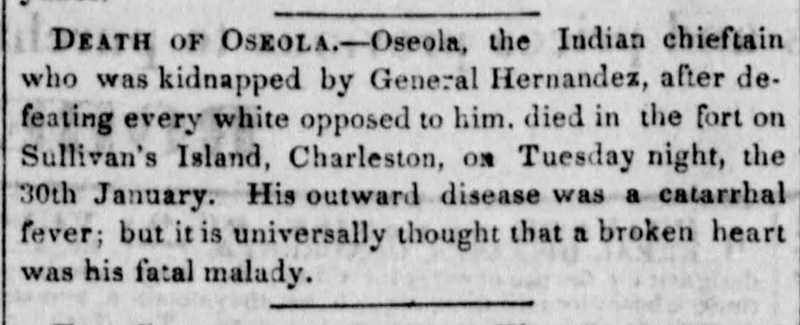
The New York Daily Hearld, February 7, 1838
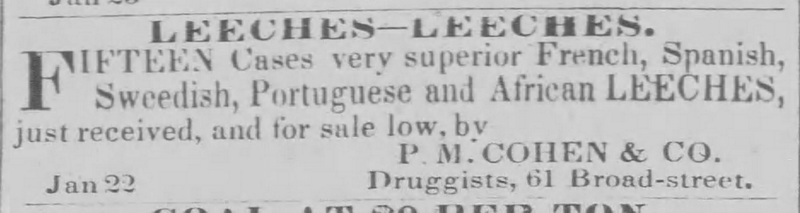
Medicine was rather primitive at the time, based on the ancient humoral
theory treatments often involved aggressive methods like bleeding or
bloodletting either directly by the doctor or by leeches which were
available at your local pharmacy.
Oceola’s death did not come as a surprise of those around him at the time, George Catlin a couple weeks earlier had said that his death was eminent. It is what happened immediately after Oceola’s death that has strange intrigue. When Osceola was close to death he asked the Dr. Weedon that his body be returned to his home in Florida so that he might rest in peace. Weedon did not honor the request, and Osceola was buried on the grounds of Fort Moultrie. But that was not all, the rumors begin from the day of his burial that Osceola head was missing when his body was buried.
[1] The article spelled the
chief’s name “Oseola”. It is typically spelled “Osceola” although Catlin
probably was most correct with the spelling “As-se-o-la”
[2] Letters and Notes on the Manners, Customs, and
Condition of the North American Indians, by George Catlin, Volume II, Wiley
and Putnam, NY, 1841, pp 219-220