


The Case of Oceola’s Missing Head
Death Mask
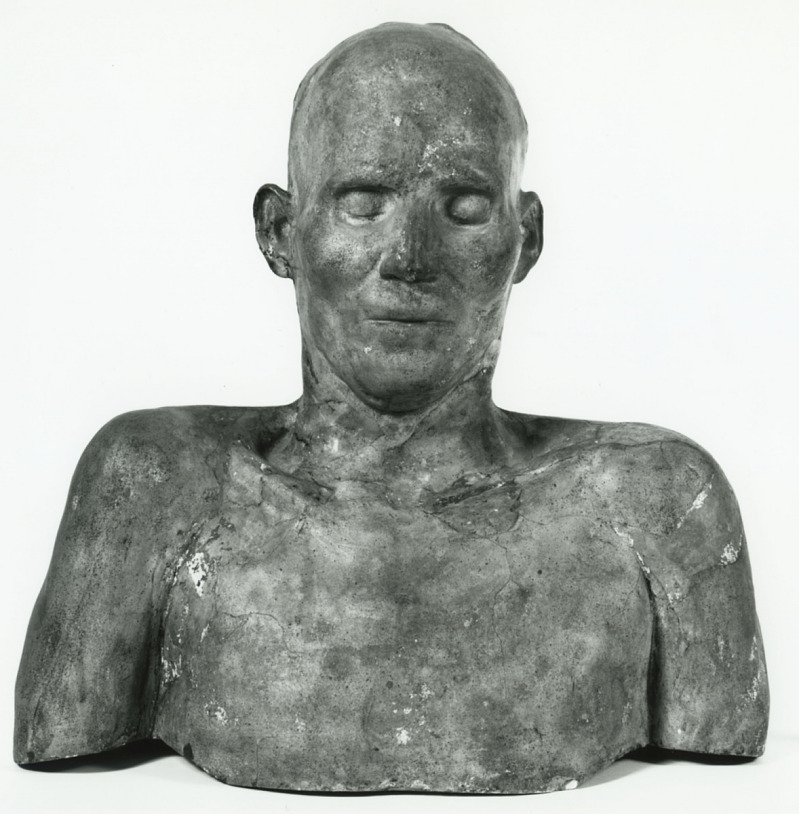
Death Cast of Osceola
At Smithsonian National Museum of Natural History
A clue to was in The Charleston Mercury on March 21, 1838:
The cast, taken from Oseola, after death, to be seen at Dr. Cohen’s, will prove quite a treasure to the Phrenologist. The head is very fully developed in the forward and higher regions, exhibiting according to the system of their science, a great preponderance of the moral and intellectual, over the animal. The large development of destructiveness and combativeness is counterbalanced by a large organ of benevolence. The organ of music is defective, and we are not musicians enough to know, whether in connection with this deficiency, his preferring as he did the trombone, to all the other instruments at the theatre, corroborates or oppose the truth of phrenology. He preferred it for its greater noise, probably; and we are not sure whether noise is or is not music. Amativeness is not remarkable, philoprogentitiveness large, inhabitiveness large, veneration very large. The outline of the forehead is perpendicular. It is altogether a very remarkable head, and the casts will be eagerly sought by Artis and men of science.
Dr. Weedon recorded in his diary how the mask came about…
January 31st
Sent to Charleston & obtained through the Politeness of Dr. Strobel on
Station, who took a cast of the Deceased.
He says that he had much difficulty in getting permission to do so but with the help of the Seminole’s Black interpreter was able to convince them to allow him. Dr. Weedon then says the body was placed in the coffin at 4 o’clock Captain Morrison “ordered that his ornaments should not to be buried, but brought to his quarters that they might be sent to Washington.” An interesting thing about this is that Dr. Weedon lied about this to Dr. Robert Lebby who he told that Osceola’s belongings had been interred with his body. Was Weedon trying to cover up what he had done?
Death masks have a long history in many cultures. One well known mask is Napoleon’s death mask. It is clear from Oceola’s death mask, which now resides in the Smithsonian, that his head was attached to his body when the cast was made.
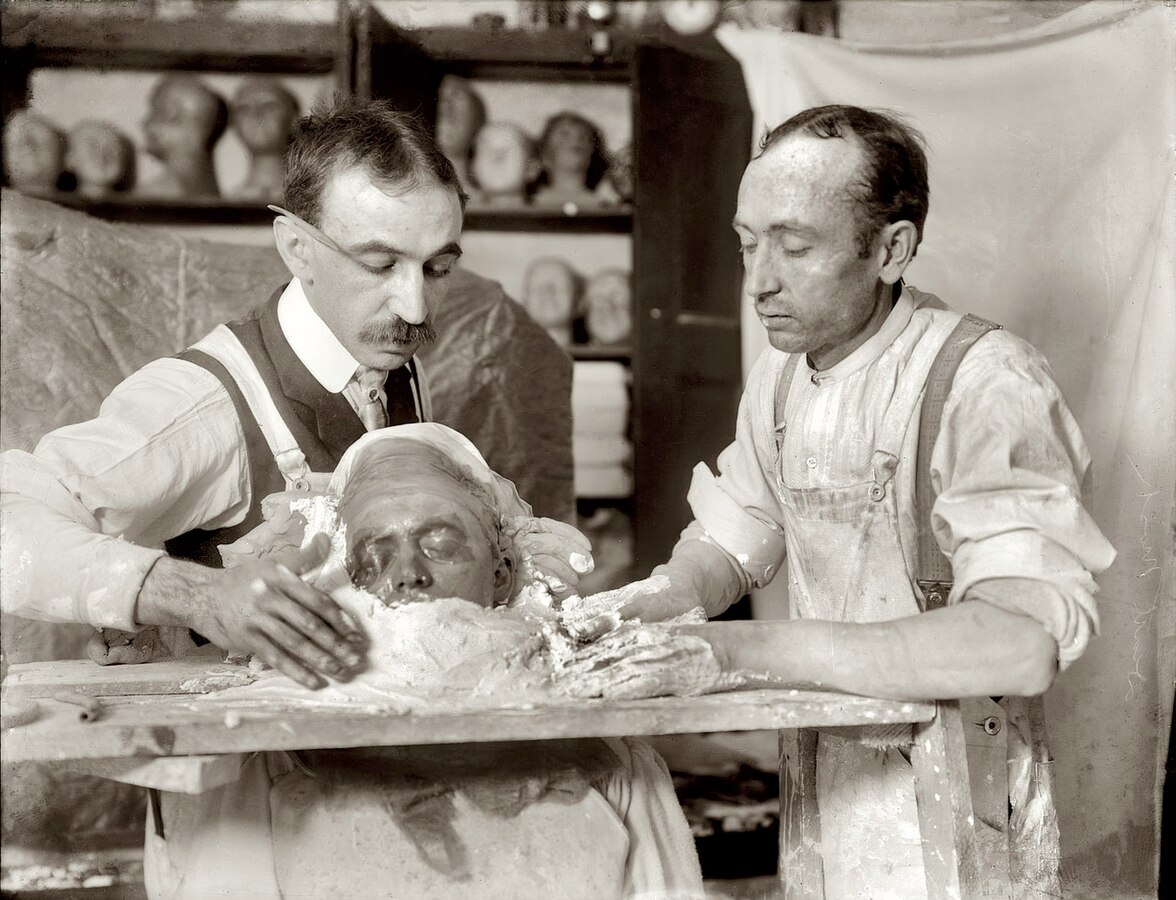
Making a death mask
Now let’s think about this for a moment… Osceola, dressed in his finest ceremonial dress, had just died with his two wives, children, and other chiefs all gathered around. The customary Seminole practice was four days of mourning before burial, but Dr. Weedon whisked off Osceola’s body, likely to the morgue, which a fort most certainly would have, and made a death mask.
Making such a mask is no easy task. It first requires ten to fifteen pounds of plaster of paris which would have been available from the Fort’s infirmary where it was used for making casts for broken bones. In large tub, add water to the plaster and mix and when it reaches a constancy a thick gravy, apply to body. Wait, Osceola was dressed in his finest dress, which would have to been removed and kept by Weedon.[1] After two to three inches of plaster were applied across Oceola’s upper torso, it would have to sit for some time for the plaster to harden. All of this would have taken considerable time, several hours. Meanwhile, the grieving Seminoles in the fort were unaware of what was happening to their beloved Osceola.
The cast was of course a negative image which would be used as a mold to then make the positive image that is now in the Smithsonian. But what about the head? It was still attached when the cast was made so why or when did it go missing.
The making of death masks fell out of favor with the introduction of photography although it was still practiced into the early 1900’s. Ulric Stonewall Jackson (U.S.J.) Dumbar, once president of the Congressional Council and a U.S. Senator made thirty-one death masks, including those of four members of the U.S. Supreme Court, and several members of various U.S. cabinets.
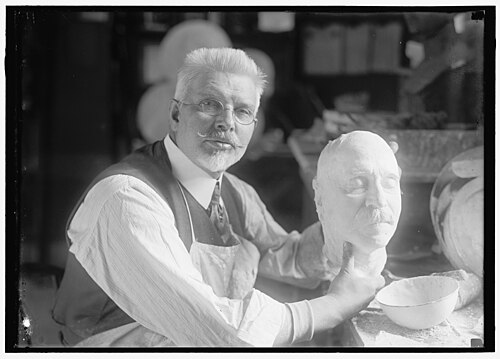
Ulric Dunbar with a death-mask of George Dewey, 1917
[1] It is known that Dr. Weedon kept some of Osceola’s belongings. Some of the objects including a wool garter and a pair of silver earbobs identical to the ones in Curtis portrait of the time were given to the Alabama Department of Archives. Osceola: Portraits, Features and Dress, by John M. Goggin, The Florida Historical Quarterly , Jan. - Apr., 1955, Vol. 33, No. 3/4, Osceola Double Number (Jan. - Apr., 1955), pp. 161-19. In the article the author comments, “It is not known whether these were giving to Dr. Weedon or weather he removed them from Osceola’s dead body, as he did Osceola’s head.”