


The Case of Oceola’s Missing Head
Phrenology
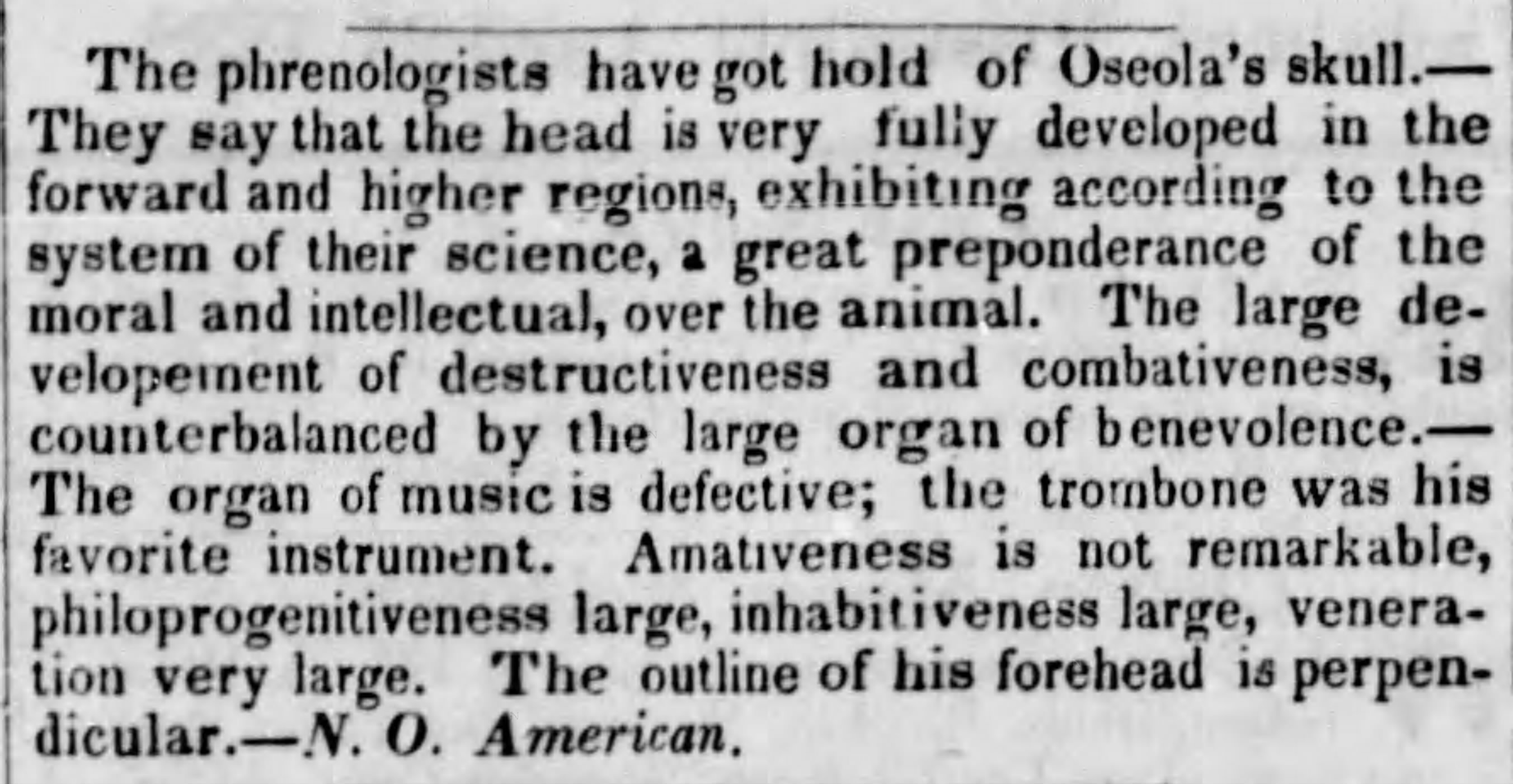
Vicksburg Whig, April 25, 1838
So what about Oceola’s head? Dr. Weedon said nothing about it being removed.
Three months after Oceola’s death an article in the Vicksburg Whig gives us a clue when says that phrenologists “got hold of Oseola’s skull.” Not the body or corpse, only the skull which would imply that Oceola’s head was no longer with his body. But who or what were the “phrenologists.” In the 1800’s the pseudoscience Phrenology was popular. Phrenology involves the measurement of the shape and bumps on the skull to predict mental characteristics of the person. It is based on the concept that the brain has functions localized in different areas and the more developed the functions were made the area bigger reflected in the shape of skull. While the first concept of localization of areas has some basis in fact, the second concept that they affected the shape of the head had no basis in truth. But people wanted to believe it, it was a scientific miracle, a phrenologist could feel the shape of a persons head and tell all sorts of things about the person. People flocked to see them.
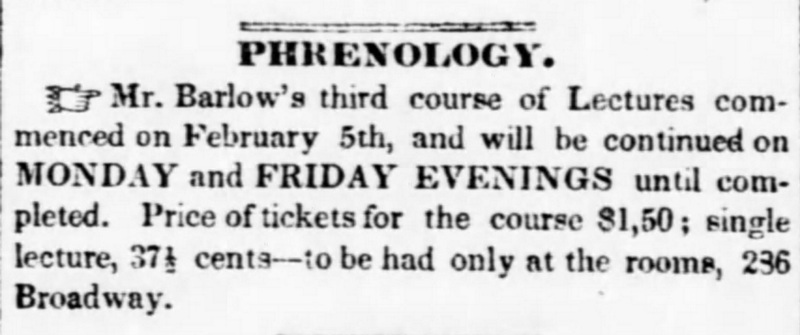
The Evening Post, February 14, 1838
Phrenology was a widely accepted scientific area of study, proven in fact as explained in 1836 comprehensive book Phrenology, Proved, Illustrated, and Applied, by the brothers Orson Squire and Lorenzo NilesFowler. Phrenology sounded very scientific, from their book.
PHRENOLOGY professes to point out a connexion between certain manifestations of the mind, and particular conditions and developments of the brain. It asserts, for example, that the feeling of benevolence or kindness, is always manifested and indicated by means of, and in proportion to, a given portion of the brain; and that the same is true of cautiousness or circumspection, of love, hatred, and reason, and of all the other mental faculties and feelings; and, vice versa, that the relative developments and various conditions of given portions of the brain, manifest and indicate the character and talents of individuals; so that the one can be always ascertained by an observance of the other.
Phrenology Proved, Illustrated, and Applied, O.S. and L.N. Fowler, W.H. Colyer, NY, 1836