


The Case of Oceola’s Missing Head
Inhabitiveness
Poems about Osceola were soon being printed in newspapers across the country.
PHRENOLOGY professes to point out a connexion between certain manifestations of the mind, and particular conditions and developments of the brain. It asserts, for example, that the feeling of benevolence or kindness, is always manifested and indicated by means of, and in proportion to, a given portion of the brain; and that the same is true of cautiousness or circumspection, of love, hatred, and reason, and of all the other mental faculties and feelings; and, vice versa, that the relative developments and various conditions of given portions of the brain, manifest and indicate the character and talents of individuals; so that the one can be always ascertained by an observance of the other.
*Phrenology Proved, Illustrated, and Applied, O.S. and L.N. Fowler, W.H. Colyer, NY, 1836
The inhabitiveness, which for Osceola’s was described as “large”, is defined in Fowlers, Synopsis of Phrenology; and the Phrenological Developments as follows:
#5. INHABITIVENESS-Love of home as such; attachment to the place where one has lived; unwillingness to change it; patriotism.
LARGE, soon becomes strongly attached to the place in which he lives; loves home and country dearly; leaves them reluctantly; is unhappy without a home of his own.
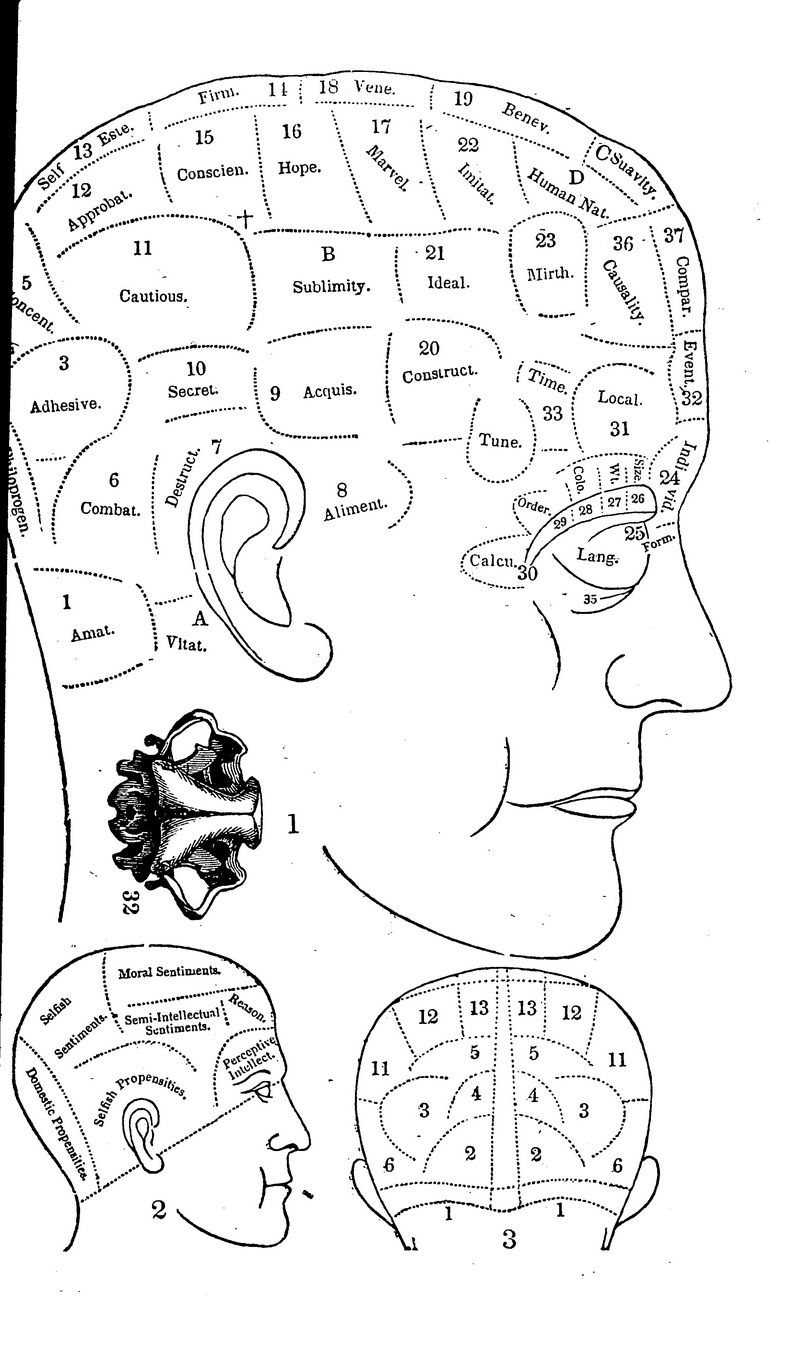
Phrenology Skull Locations
#5, Inhabitiveness located at back, center
Illustration from
Synopsis of Phrenology; and the Phrenological Developments
By O.S. Fowler, The Phrenological Athenaeum, Philadelphia, 1838