


The Old Country
1845
David Levy Yulee
On Dec. 26, 1845 David Levy petitioned the Florida Senate to change his name to David Levy Yulee, with Yulee being his mother’s name. The petition passed on January 12, 1846 with 32 yays and 18 nays. David Levy Yulee was the first and only man in Florida history to have his name changed by an act of the legislature. After his brother Elias, who was residing in Georgia, heard the news he also changed his last name to Yulee.
David Levy explained why he petitioned for a name change in a letter to the St. Augustine News, he wrote:
"The name which my father inherited was that which I asked permission to resume. It was his pleasure to suspend its use after leaving his parental home and employ the name of Levy in its stead. For reasons which will naturally suggest themselves to every heart that holds in proper regard the memory of those through whom we trace our being and lineage, I have thought it becoming in me, as a reverential duty, to reclaim the name and restore it to a place in the register of the human race.”
But there was a slight issue, the writing of the act mistakenly spelled the change as “Eulee” instead of “Yulee”. An article in the Florida Sentinel on January 27th pointed out the error and asks, “Can our Senator lawfully make this second change in his name, with out a special act of our Legislature, - and has he not as clear a right to call himself “Mulee” as “Yulee?” and then went on to say, “it appears that no such person as “David Levy Eulee,” claims membership in [the Senate].”
David’s father, Moses Elias Levy also commented about his son’s name change.
To the Editor of the St. Augustine Herald:
Sir: I herewith return the article to which you called my attention, explaining the motive which induced Senator David to change his name to that of Yulee.
If the garbled story of the family satisfactorily answers the question to the mind of the writer, it cannot give any reasonable cause why I should have changed mine.
Some political enemies of D. Yulee were industrious enough to circulate about that he gave out for a reason, that I had committed some act in my native country which obliged me to change my name, when I emigrated, and this too was persisted in when I assured the immediate information that I was but ten years old at the time.
I have printed record by me to show that my father was known but by the name of Levy. Ture it is, that the family name was that of Yulee, but surnames are little thought of by Orientals particularly; a Levite with the Jews is call but Levy. The family name is used only in signing of documents.
When I emigrated to St. Thomas, I dropt the family name to my signature, to avoid being called by any other name than that which I was known by since my birth.
Some of my people find the name an inconvenient travelling one, even in the most tolerant countries in the world, but this was but an additional reason, and a strong one it is to my mind, if there was not other, to have retained it.
With esteem, your well wisher, etc.
M. E. Levy
St. Augustine, 19th Feb., 1846
Florida Herald and Southern Democrat, Feb 24,1846, p4
In 1846 David Yulee married Nancy Wickliffe, daughter of a former governor of Kentucky and postmaster general in the Tyler administration and who was a Presbyterian. The marriage increased the alienation from his father, after David going into politics, changing his name, and now, marrying a Presbyterian. David’s father, Moses later wrote that his son’s “failure to identify himself actively with the Jewish religion" was one of his biggest disappointments. In letters that he wrote to Rebecca Gratz in Philadelphia, Moses Levy lamented that "all of my grandchildren are Christians."
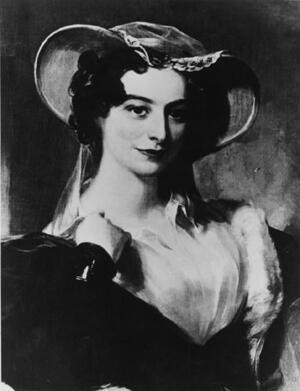
Who was this Rebecca Gratz which Moses wrote letters to about his philosophical theories and personal issues? Rebecca Gratz was the devout daughter of a wealthy Sephardic Jew and an important Jewish woman in ante-bellum America. Rebecca Gratz probably knew Moses Elias Levy through her work in founding the first Jewish Sunday school in America, which she established in 1838. She knew of Levy's prior effort to establish a Jewish school at his settlement in Florida and he in turn knew of her many good works and was acquainted with her father, one of the most successful Jewish businessmen in the country.
Rebecca Gratz was the first to apply the “Protestant” Sunday school format to Jewish education, she created lesson plans and materials, taught classes, and raised funds for schools that would teach both boys and girls, in English, about Jewish religion, history, and culture. Her model for Jewish education quickly spread to other cities, becoming the standard for the modern Jewish Sunday school.