


A Bit of History
Edward Wanton and Horatio Dexter
1821
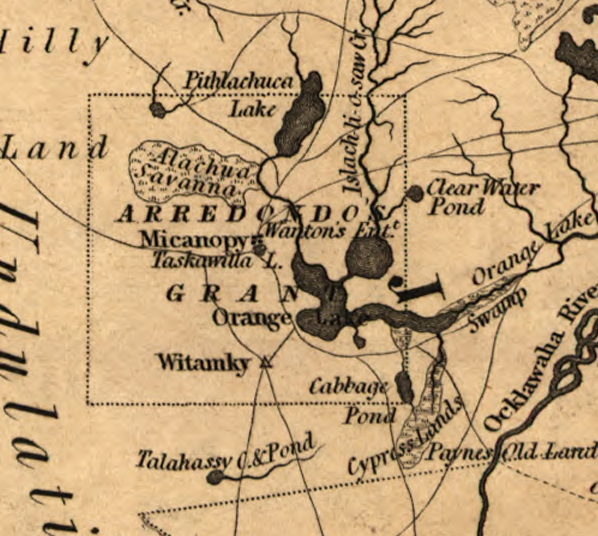
1823 map showing Micanopy and Wanton’s just south of the Alachua Savana
Click to see full map
Dexter and Wanton’s success with negotiating with the Seminoles led them to offer their services as Indian agents to the territory of Florida government which did not please, the now president, Andrew Jackson who issued an order for their arrest describing them as “unprincipled individuals” attempting to “Fleece” the Seminoles.[1]
Andrew Jackson view about the native Indians had been clear since he marched after them from Georgia to Pensacola under the Spanish rule in 1818. Now the Governor of the Florida Terrorist, expressed his views in a letter to the Secretary of State about the Indians in Florida saying[2] that he “Upper Creeks” who came from NC,SC “ought to be ordered up to their old places of abode within the Creek nation”, and for the Indians in Fla “induce them to embrace an agricultural life.” He the suggested that Congress set off a tract of country for them, and fixing a boundary between them and the settlement of the Whites. Basically, round them and confine them.
A major issue for the for the new Territory was what land was public, and what was privately owned. In the same letter to the Secretary of State he said, “The lands and the land titles of the Floridas require the most serious attention of Congress.”
Some land ownership was quite clear, particularly around the settlements of St. Augustine and Pensacola but of the vast interior of Florida it was not so. In the last few of years of Spanish rule numerous land grants were given right up to the transfer of Florida to the United States. Each of these grants had to be investigated and determined if they were valid and the conditions of the grant were upheld. One of the largest such grant was the 289,645 acre grant in the center of Alachua County, the Arredondo Grant of which Jackson wrote, “that a grant has been made since the 24th January 1818, by the Captain General of Cuba to Arredondo for a large tract in the Alachua plains, and which I have very reason to believe is fraudulent.”
Ironically, Indian relations deteriorated such that the Florida territorial government engaged Dexter’s services to engage with the Seminoles which led to the Treaty of Moultrie Creek in 1823. Meanwhile, Wanton focused on the settlement of the Arrendondo Grant and received a grant of 1,667 acres and a yearly salary of $500 and by March of 1821 two houses had been built with Wanton as the sole white inhabitant. Because it was mostly a black community, the Seminoles tolerated it. The following year several additional structures were added including slave quarters, a kitchen,[3] an Indian trading store, and a large log-house enabling his family to join him and the settlement increased to around fifteen persons.
In February 1823 the Seminoles so respected Wanton that they supplied him with abundant game which was rare as the Seminoles discouraged white settlers. Early in 1823 Dexter, who had a falling out with Wanton, and approximately a dozen Indians, some of them chiefs, came to Wanton’s to burn the settlement but Wanton convinced them to leave peacefully. The Seminoles concluded that since they “had given him permission to stay they would not ask him to go.”
By the end of 1823 the settlement had grown substantially allowing for further settlers to arrive but settlers were still hard to find that would move to such a primitive place deep within Indian territory. To find settlers Arrendondo turned to Moses Elias Levy.
Notes:
[1] #61,pp205
[2] #61, pp231-235
[3] At the time kitchens
were typically separate structures due the risk of the cooking over open
fire burning down the building.
Updated: 2026-06-10