


A New Capital
Simmons
1822
Simmons First Trip To Wanton's
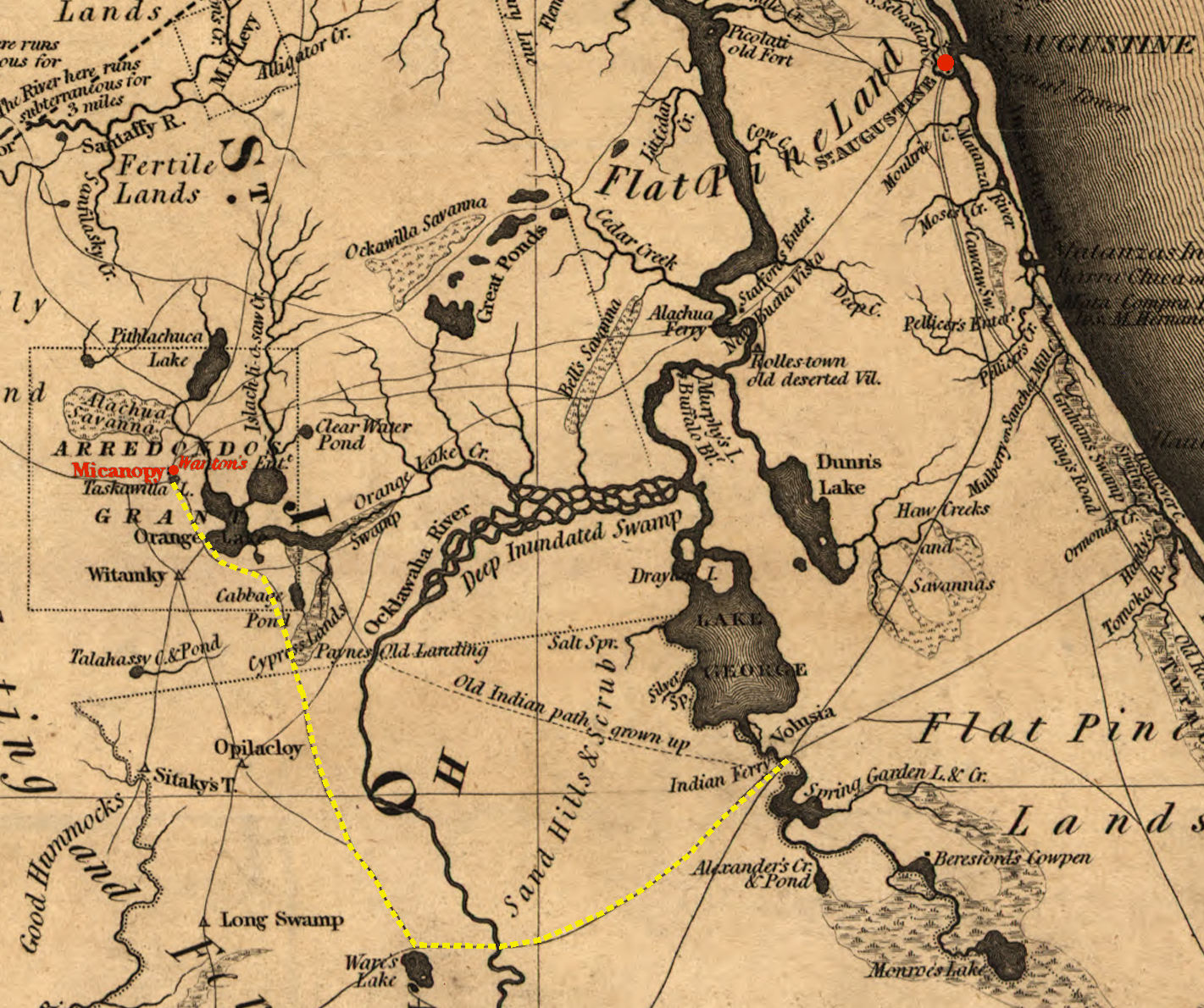
Simmons 1822 route to Wanton's (Yellow)
With the onset of winter, the yellow fever epidemic in St. Augustine had abated and Simmons, free of his doctor duties, made and excursion to Alachua, Simmins writes,
Accompanied in these excursions by Mr. Horatio S. Dexter, a planter of the Province, whose intelligence, long residency in the country, and inquiring mind, had put him in possession of a great deal of information, which was liberally imparted to [Simmons]; who avail himself of this opportunity, to acknowledge the further obligations, which he owes to this gentleman, whose boats, horses, and other facilities for travelling, were freely place at his command; and by whose house, he was long most kindly and hospitably entertained.
Simmons left St. Augustine on December 29th, 1822 and traveled up (south) the St. Johns to Dexter’s at Volusia, at that time, the southernmost settlement on the St. Johns. On one excursion with Dexter, they travel to “Silver Springs” by the way of Lake George,[1] “of which so romantic an account is given by Bartram, [Simmons] found it well worth the trouble of a visit,” and described it “as transparent as air, or melted chrystal.” It was on one of these excursions that Simmons traveled to Wanton’s describing him as “a gentleman of the Province, well known for his integrity of character.”
Following the path mentioned by Vignoles, Simmons set out from Volusia on February 5th 1822 heading to Alachua accompanied by an Indian Negro guide. Simmons says that he, “much regretted that that business prevented Mr. Dexter from bearing me company on this excursion.”[#66]
After taking the ferry across the St Johns River, they headed westward passing through low hammocks, and pine barrens interspersed with small ponds and lakes and passing what he called Lake Wortola, the Indian name for whooping crane. They made good distance and that night they encamped about eight miles from the Ocklawaha River. In spite of heavy rain that night, they, “were enabled to kindle a fire without difficulty, by the help of the lightwood, which lay in abundance around. This fuel is, truly, the traveler’s friend, as it affords him a hearth in the wilderness in the worst weather, burning inextinguishably, in the heaviest showers.” Lightwood, also known as lighter wood or fat-wood, is pieces of pine heavily laden with pine sap which, easily lit, burns readily. My dad taught me about fat-wood when I was a boy when he used fat-wood which was always kept in a tin bucket next to the fireplace to start a fire in the fireplace at grandma’s house.
That night Simmons took cover under a cow-hide which they had brought to protect their baggage and to form a boat for the purpose of ferrying over the Ocklawaha. In spite of the cow-hide, a blanket and his surtout he was soaked through and he had a very unpleasant night.
To make matters worse, in early morning the horses charged at full speed by the camp, they believed startled by a wolf which they heard howling. The guide set out at daybreak to find the horses and was gone so long that Simmons thought the guide had deserted him, but in time the guide returned with the horses, and they resumed their journey reaching the Ocklawaha in about an hours’ time. They had intended to make a small boat from the cow-hide to ferry their belongings across the river but it was so soaked from the previous night’s rain they deemed it not to be sea-worthy. It was common for a cow-hide to be stretched over two cross sticks to which the hide would be lashed to form a bowl-shaped boat that was then used to transport, not the people, but the supplies across the river. Without the makeshift boat, they took off their clothes to keep them dry and then swam across the river on horseback. Simmons said, “As it continued to rain, I found undressing in a shower a very unpleasant part of the undertaking.”
After crossing the Ocklawaha, they found the land more elevated and scattered with numerous ponds and lakes with the most notable being Lake Ware (now Lake Weir) which the road ran along the lake’s beach. In 1948 my grandfather, Fred Junior, built a roadside tourist stand in the town of Ocklawaha on the north side of Lake Weir. Simmons describes Lake Weir,
The forest, at present, forms a virgin cestus around it; and it pure waters, unpassed, as yet, but by the wing of the eagle, or the wild-duck, are so extremely clear, as to admit the Sun’s rays to a considerable depth; and the light may, for some distance, be seen, playing upon its bed of silver and sand.
Heading northward from Lake Weir they came across more of what Simmons at first said were Whooping cranes in a pine barren. He said he was later informed “upon better authority” that the birds often could be found on drier grounds for the purpose of eating gravel and thus were called the Sand-hill crane which Simmons said were “very fine eating.” The cranes were almost assuredly Sandhill Cranes which were more common. Simmons said, “its extraordinary croak or whoop, may be heard echoing from a great distance,” and was called Wortola-lacha by the Indians. The larger Whooping Crane, called Wortola hatki by the Indians, is less common, which Simmons said the Indians described as white with black tip wings and has a “very plaintive and pleasing note”.
While plentiful in during Simmon’s time, the 1930s Sandhill cranes were decimated east of the Mississippi. Growing up in Florida in the 1950-1960’s Sandhills were never seen, but in the late 1990’s Sandhills made a recovery. I remember going to visit my parents in Gainesville Florida for Thanksgiving in the early 2000’s and hearing their whooping call as they flew in a V formation high overhead. Dad said they did so the same week every November. When I moved into my new house in Gainesville in 2018 three Sandhill cranes spent every several days at the vacant lot across the street.
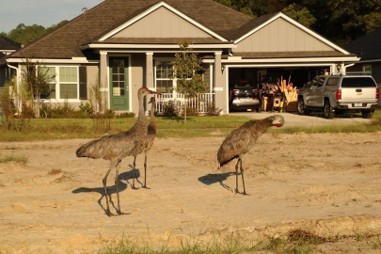
Sandhill Cranes in 2019 in the vacant lot across the street from my new
house which is in the background.
As they proceeded northward Simmons said they intended to spend the night at a Negro settlement at the Big Swamp before nightfall, but after frequently losing the trail due to his guide having never traveled the route before, they had to retrace their steps several times. Finally, they came across a small Indian village where they asked directions and reached the Negro settlement about 11 o’clock that night. It seems that Simmons choose to spend nights at the Negro settlements rather that the Indian settlements, likely being more welcomed or perhaps in part due to Simmons having a Negro guide. The Negros settlements were often composed of both free Negros, runaway slaves and slaves of the Seminoles, which were accepted by the Indians with some groups becoming so integrated with the natives that they became what is known as Black Seminoles. The head of the village Simmons arrived at was a Negro named Cudjoe who accepted Simmons into his village providing him a bunk by the fire, which on the cool February night might have been welcomed, but Simmons said he was prevented from getting much rest due to, “The smoke and the conversation of the Negros, who sat up till a late hour.” Simmons the Negros being, “in the greatest poverty, and had nothing to offer.” Simmons went on to say,
There was, also, a general impression among them, that the Americans would seize upon all the Negro property of the Indians; and the latter were also induced to believe, by design persons, that the Americans would rob and treat them with every degree of injustice and oppression.
The following years would prove them to be correct. Simmons sums up his view on the subject as follows:
It is with great reluctance that I touch upon this subject; but, as years roll on, without to our interest and character, I should deem it criminal, in adverting to the topic, not to mark with reprobation, however little it may be calculated to produce effect, the callous indifference evinced in all the slave holding states, upon this subject.
February 7th, In morning Simmons parted with his guide who had to go to Vibrilla with the horses to meet some new settlers who he was to take to Alachua. With his guide gone, Simmons obtained a new guide and horses from the Negro village and proceeded to the next town. The pace was slow due to what he described as the “miserable ponies” could hardly walk although he said the leisurely pace allowed him time to observe the country though which they passed. After emerging from the Big Swamp they traveled though a dozen miles through pine land before traveling though an area of poor quality with a growth of stunted pines intermixed with small scrub oaks. This was what is now the Ocala National Forest lying west of Lake George, which if you now drive down Highway 19 which runs through the center of the Forest, you would miles of untouched land on the same basic route that Simmons followed in 1822.
[1] What Simmons called Sliver Springs on Lake George was actually what is now called Silver Glen Springs, see story. Sliver Springs proper is located thirty or so miles west on the Ocklawaha River.
Updated: 2026-08-07