


A New Capital
Simmons
1822
Ocala National Forest
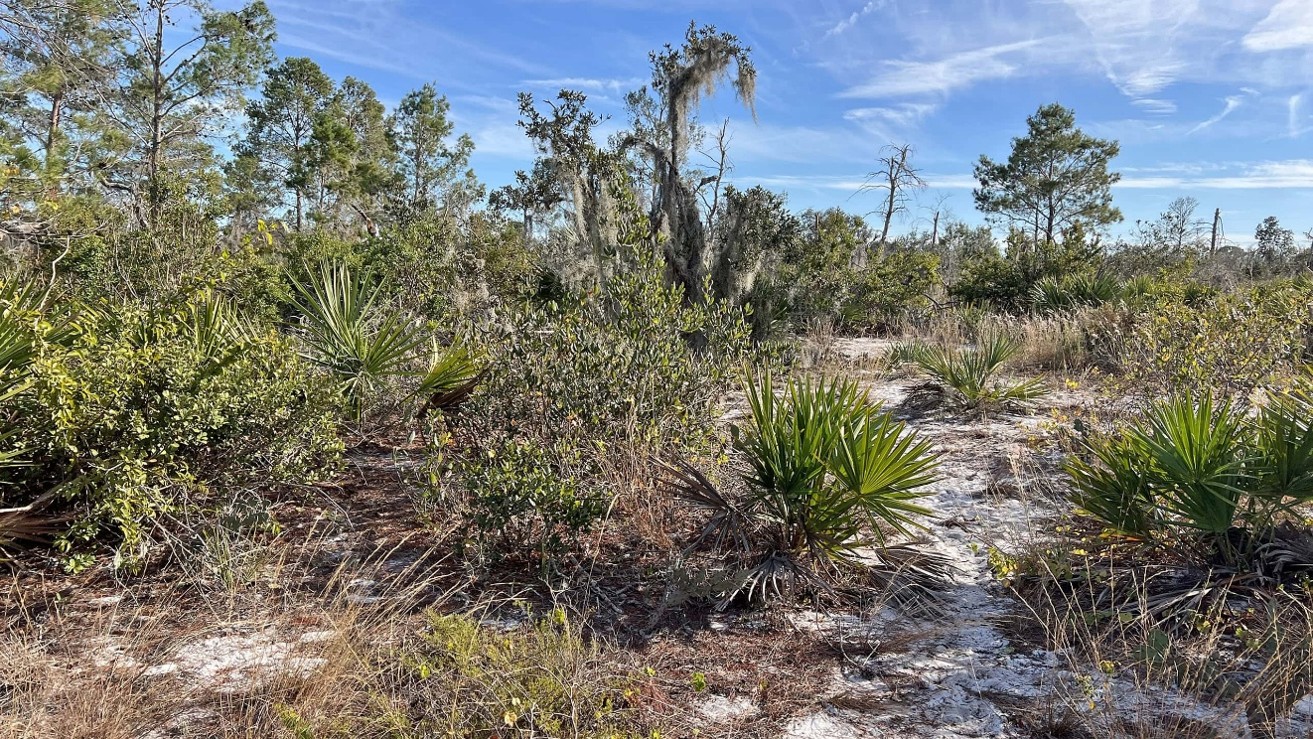
Stunted pines, scrub oaks and palmettoes Typically view along Highway 19 in
the Ocala National Forest
As they proceeded northward Simmons said they intended to spend the night at a Negro settlement at the Big Swamp before nightfall, but after frequently losing the trail due to his guide having never traveled the route before, they had to retrace their steps several times. Finally, they came across a small Indian village where they asked directions and reached the Negro settlement about 11 o’clock that night. It seems that Simmons choose to spend nights at the Negro settlements rather that the Indian settlements, likely being more welcomed or perhaps in part due to Simmons having a Negro guide. The Negros settlements were often composed of both free Negros, runaway slaves and slaves of the Seminoles, which were accepted by the Indians with some groups becoming so integrated with the natives that they became what is known as Black Seminoles. The head of the village Simmons arrived at was a Negro named Cudjoe who accepted Simmons into his village providing him a bunk by the fire, which on the cool February night might have been welcomed, but Simmons said he was prevented from getting much rest due to, “The smoke and the conversation of the Negros, who sat up till a late hour.” Simmons the Negros being, “in the greatest poverty, and had nothing to offer.” Simmons went on to say,
There was, also, a general impression among them, that the Americans would seize upon all the Negro property of the Indians; and the latter were also induced to believe, by design persons, that the Americans would rob and treat them with every degree of injustice and oppression.
The following years would prove them to be correct. Simmons sums up his view on the subject as follows:
It is with great reluctance that I touch upon this subject; but, as years roll on, without to our interest and character, I should deem it criminal, in adverting to the topic, not to mark with reprobation, however little it may be calculated to produce effect, the callous indifference evinced in all the slave holding states, upon this subject.
February 7th, In morning Simmons parted with his guide who had to go to Vibrilla with the horses to meet some new settlers who he was to take to Alachua. With his guide gone, Simmons obtained a new guide and horses from the Negro village and proceeded to the next town. The pace was slow due to what he described as the “miserable ponies” could hardly walk although he said the leisurely pace allowed him time to observe the country though which they passed. After emerging from the Big Swamp they traveled though a dozen miles through pine land before traveling though an area of poor quality with a growth of stunted pines intermixed with small scrub oaks. This was what is now the Ocala National Forest lying west of Lake George, which if you now drive down Highway 19 which runs through the center of the Forest, you would miles of untouched land on the same basic route that Simmons followed in 1822.
Simmons was traveling along the great sandy ridge that runs down the center of the state from which the waters on the west flow to the Gulf of Mexico, and the waters on the east flow into the St. Johns. Traveling north they traveled along the ridge crossing between the Withlacoochee River on the west that flowed into the Gulf and the Ocklawaha River on the east that flows into the St. Johns. Along the way they passed a several of Negro travelers which Simmons explained many were refuge slaves with some having fought with the Spanish against the Americans. With his guide they continued on after nightfall reaching another Negro village late in the evening. This settlement was in better condition than the night before and he “lodged in a new and excellent house … constructed in the Indian manner with out nails,” where under the “smokey rafters,” he was lulled to sleep by the “compelling sound of an incessant shower”, upon the thatched roof and he fell asleep upon a bed of deer skins. Simmons described the people of village people as having,
“The union of ignorance and civilization, as displayed in the manners of these people… [having] many striking virtues, and a simplicity of character, that are wholly wanting in the [white man] who are mostly, in fact, plunged in the grossest vices, and brutal in manners, and ever ripe for the commission of outrages and crimes.”
Awaking refreshed the following morning he awoke to find it still raining. He said the Negros had no food to offer him, so he made a breakfast of coffee with some dry bread and bacon from the provisions he had brought with him. He describes the “road”, not more than an Indian trail, passing though the driest, and therefore the poorest land but he did see fields planted by the Negros who said the land had been cultivated by the Indians for at least fifty years but the land still continued to produce well showing how fertile the land was. Lands in the northern states had been worn out in half that time, one of the reasons settlers in South Carolina and Georgia later migrated to Florida. This area would later become Levy and Marion counties and have some of the best farming land in Florida. Phosphate was discovered in the area in 1881 which accounted for the sources of the land’s fertility. The phosphate was extensively mined in later years for fertilizer.
About one o’clock on February 8th, after traveling seventy some miles from Volusia, Simmons arrived at Wanton’s where he was most hospitably received.
Updated: 2026-08-07