


A New Capital
Wanton’s-Micanopy
1821
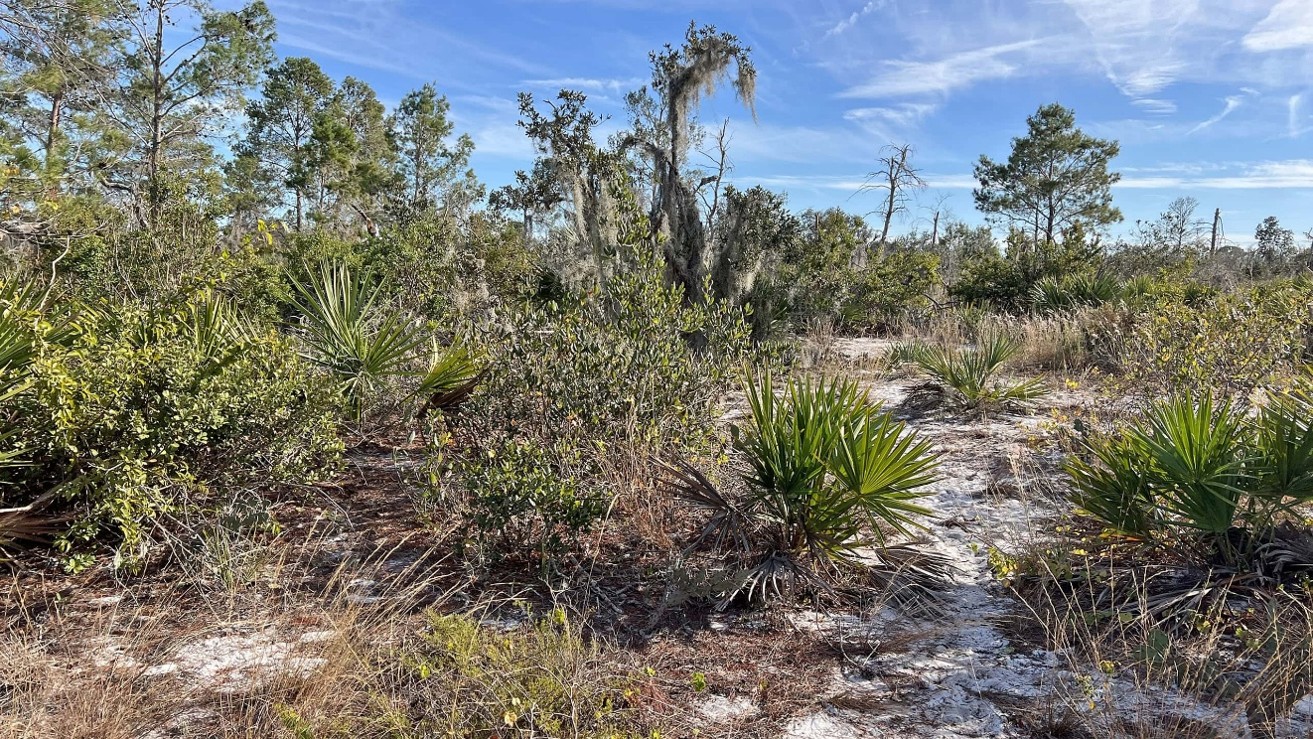
Stunted pines, scrub oaks and palmettoes Typically view along Highway 19 in
the Ocala National Forest
Wanton’s established by Edward M. Wanton assisted by Horatio Dexter, was the first settlement in the interior of Florida. In his testimony to the Supreme Court about the Arredondo Grant, Harman H. Holliman described Wanton’s in the fall of 1821 when he “visited the neighborhood of Paines Prairie.”
Wanton’s, 1821
We remained at Wanton's about two days, Mr. Wanton had two or three Small Cabins, having been recently built-and a large log house unfinished- We understood that Wanton was permitted by the Indians to make this establishment solely because he intended to erect a store house to trade with the Indians[1]
Wanton had been granted permission to settle in the area by the Seminole Chief Micanopy for which Wanton then said he would name the community in honor of him. Micanopy-Wanton’s is shown on Vignoles 1823 map of Florida. Wanton’s settlement would later be key in determining the ownership of the 250,000 acre Arredondo Grant in a case that was not settled until 1832 by the U.S. Supreme Court.
---
Simmons described the settlement in 1822 with the, “intended town of Micconope” being situated on an elevated spot on the northwestern boarder of Cuscowillia Lake, near the site of the ancient town of Tuskawilla. Tuskawilla, or Cuscowillia, as described and visited by William Bartram in 1773 consisted, “of about 40 houses; placed pretty near to one another, surrounding a large open square, in the center of which stands their Counsel house.” Now, fifty years later, Simmons said all that remained was, “a few wild plumb trees, and corn hills, mark the spot where the rude forefathers of the wigwam once dwelt.” Simmons described settlers at Wantons as, “having a great deal of enterprise, and the necessary means, were about introducing a large body of industrious settlers; by who, the wilderness will soon be converted into a smiling scene of cultivation, and civilized improvement.” And then that the, “settlement was effected at great expense, and under many difficulties, by the hardy enterprise and perseverance of Messrs. Dexter and Wanton, assisted by the resources of Mr. Mitchell.”
It is interesting to note that Simmons says the “intended” town of Micconope for Wanton’ had only recently negotiated with Chief Micanopy to allow settlement and one promises made to the Chief by Wanton was he would name the settlement after him. It wasn’t until Vignoles 1823 map that, with the spelling of Micanopy, it was literally put on the map.
It was during this visit to Wantons that Simmons thought that it could become the capital of the new Florida territory Simmons writing,
The incipient town of Micconope, will, probably, be fixed on as the seat of government for the Floridas, as it is sufficiently intermediate between St. Augustine and Pensacola, if the route from the latter place, be pursued partly by water, as far as the Suwany, or Tampa Bay.
Simmons introduced this at the Second Legislative Council of Florida held in St. Augustine in 1822, but it would be rejected as being too far from Pensacola. Micanopy was only about 80 miles west of St. Augustine, but over 300 miles from Pensacola. This decision would have a major impact on his life.
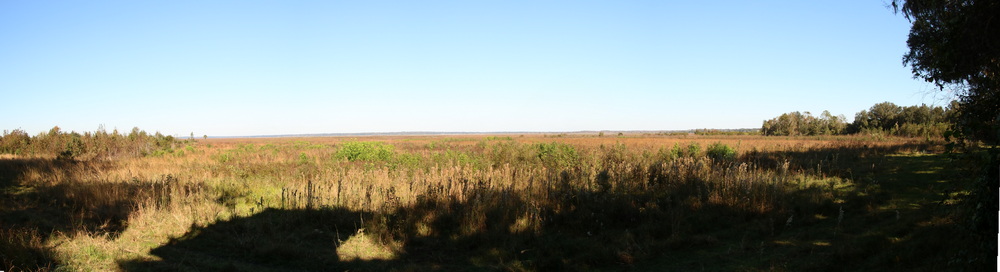
Alachua Savana in the Winter
(Paynes Prairie, LM 2019)
The following morning Simmons awoke from a deep and refreshing sleep with the Sun’s “rosy rays” shining though the forest out the widow of the log cabin in which he slept. After a week of “gloomy obscuration” it was most welcome. After a hardy breakfast, Simmons set off on an excursion with Wanton’s friend, Mr. Mitchel, to the Great Alachua Savana with two Indian Negro guides belonging to the son of the local Seminole, King Hijo. Lying about five miles north of Micanopy, it didn’t take them long to reach the Savana, which Simmons said, he was “somewhat disappointed in its appearance, owing, no doubt, to it present russet, and winter aspect. In the spring, when it exhibits a green and flower carpet bordered by stately shades, it must afford a very picturesque view.” He goes on to describe the savanna in more detail,
It is surrounded by rich hammocks, some of which, point like promontories into the sea of grass; while others appeared like islands in the level waste of weeds. These primeval groves of nature, here exhibit a verdure and altitude, that are, perhaps, no where else to be paralleled. The live oaks, in particular, attain to a surprising magnitude. The tallest pines and laurels, are, absolutely dwarfed beside these Titans of the shade. Their great numbers and massiness must, I should suppose, present a very serious obstacle to the clearing of the lands.
The savanna, in many parts, had the appearance of a beautiful lake, whose purple expanse, bordered by lofty groves of level fields of reeds, afforded a novel and pleasing prospect. Though two or three feet deep in water, in many places, I was told, that it often quite dry in summer.

Me standing in front of the massive, 36 foot circumference, Cellon Oak in
Alachua County a few miles from my house.
Simmons said later that they found one of the massive oaks laying on the ground, cut down by the Indians to get to a honey bee hive in the top, and found it to be thirty feet in circumference.
[1] Territorial Papers, Notes-v24, P781, 1821 Wantons description in deposition by Harman H. Holliman.
Updated: 2026-08-07