


A New Capital
John Lee Williams
1823
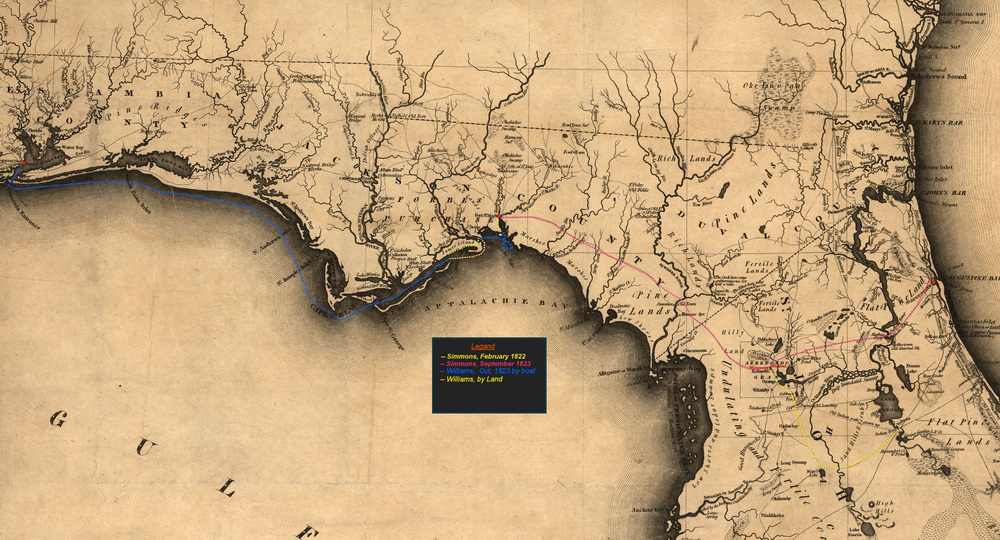
Williams Route (blue) to Fort St. Marks
So where was Mr. John Lee Williams who was to meet Simmons? Williams, the commissioner representing East Florida, lived in Pensacola, a distance of 250 or so miles west of St. Marks, a distance easily travel by boat in a few of days. Williams set sail on September 30th and after eight days of unfavorable winds, reached what they thought was Apalachicola where their ship ran aground upon a shole. It turned out it wasn’t but wasn’t Apalachicola, but was St. Joseph’s bay, Willliams explaining that he had been unable to procure a map or chart of the coast in Pensacola. After waiting for the next high they freed the boat and continued. On the 10th of October, when Simmons had reached St. Marks, Williams was only halfway there by sea.
Three days later they reach the Apalachicola Bay where they found the collector of the port, Major Jenkins with whom they dined with while waiting for the tide to turn so they could cross the mouth of the Apalachicola River so they anchored off of St. George’s Island which Williams spent the day exploring. Here they met with some bad weather, “It began moderately, but rapidly increased in violence, until it put out our fires, sunk our boat and threatened staving it in pieces. We were perfectly drenched with rain and all our baggage shared the same fate.” Williams does not describe their boat but evidently it was not very large, possibly a single mast sloop. The following day was not much better, Williams writing, “The morning brought us no relief. On the contrary, a sudden rise of the tide, occasioned by the sea breaking over the island, threatened to drown us out.” Desperate, in torrential rain they bailed out the boat, reloaded it “with great difficulty, and sailed out of the bay.” The following day they crossed over some shoals and reefs which at one point had to drag the boat nearly four miles over them.
On October 18th they finally got a break weather but found the tide had left their boat aground and so they had to wait for the next high tide while Williams, “took a pleasant ramble on the seashore, which was strewn with the effects of the late storm. Cockels, conchs, mussles, escollops, newts, medusas, mosses and coralines lay bleaching in the sun, with an infinite number of smaller shells.” The following morning they caught a dying pelican whose pouch was “chocked full by a fish” which had had got stuck in the pelican’s pouch. Williams said, “The fish afforded us a fine meal.” After their meal the tide had come in and set the boat afloat and with “all taking to the oars” set off going through the pass between St. George’s Island and Dog Island. About ten miles past what is now Carrabelle on the New river they anchored for the night and went ashore to get fresh water and provisions. Williams wanted to continue but the Captain and his boy had lost all their provisions on the fourth day, so Williams stayed and shared his meager provisions with them.
The following day Williams says, “Vexed with eternal unnecessary delays, I determined to attempt the passage by land, accordingly I left the boat,” and set off at dawn taking “many articles as I could conveniently carry and proceeded up the coast.” Walking along the beach Williams came across, “part of the vertebra of an enormous fish, they were fourteen inches in diameter. The balance of the skeleton, with a huge mass of decaying flesh,” Likely a dead whale. At sunset he camped on the beach where, later that evening, the boat had traveled and caught up with Williams and Dr. Foster who also was on the boat came ashore and visited Williams.
The next morning, Williams set out at half past five, traveling on the beach before “toiling” through ponds, swamps and marshes of the Ochlocknee river delta. That evening, about files miles from the Ochlocknee Bay, he made dinner of a crab and oysters which he caught. The following morning after a breakfast of oysters, he set out building a raft to cross the bay which proved difficult due to the pines and oaks growing there did not float so he collected driftwood on the beach for the raft. The following day the wind and tide made the bay too rough to cross so he spent the day exploring the area. The next morning he set out on his raft at low did but his raft proved to be not very seaworthy and he was, “obliged to paddle with great energy to keep it from sinking.” After crossing the bay he saw the boat which he had been on stopped in the bay for the evening. After resting for a few hours, he traveled about four miles when he, “became faint and blind with fatigue, hunger and thirst,” and called to the boat which had continued in sight offshore. After boarding the boat, they reached the Indian pass of the Apalachicola River by nightfall.
The flowing morning, they heard gunshots coming from land which they thought was the fort but after continuing until noon they didn’t find it, so thinking they passed it, they turned around and sailed back the way they came. At 3 p.m. they entered what they thought was the river where they anchored for the evening then at midnight, Williams noticed the flow of the tide into the river, and knowing it wasn’t far, he woke Dr. Foster and the two of them rode for three hours to Fort Marks where they were greeted by Lieutenant Hutton. Captain McClintock the commander of the fort was away having accompanied Dr. Simmons “into the country”.
On October 24th, after 26 days of travel by water and land, Williams reached Fort St, Marks, finding Simmons, who had been waiting at the fort for Williams for fourteen days, had gone off to explore the countryside.
Updated: 2026-08-07