


A New Capital
Simmons and Williams
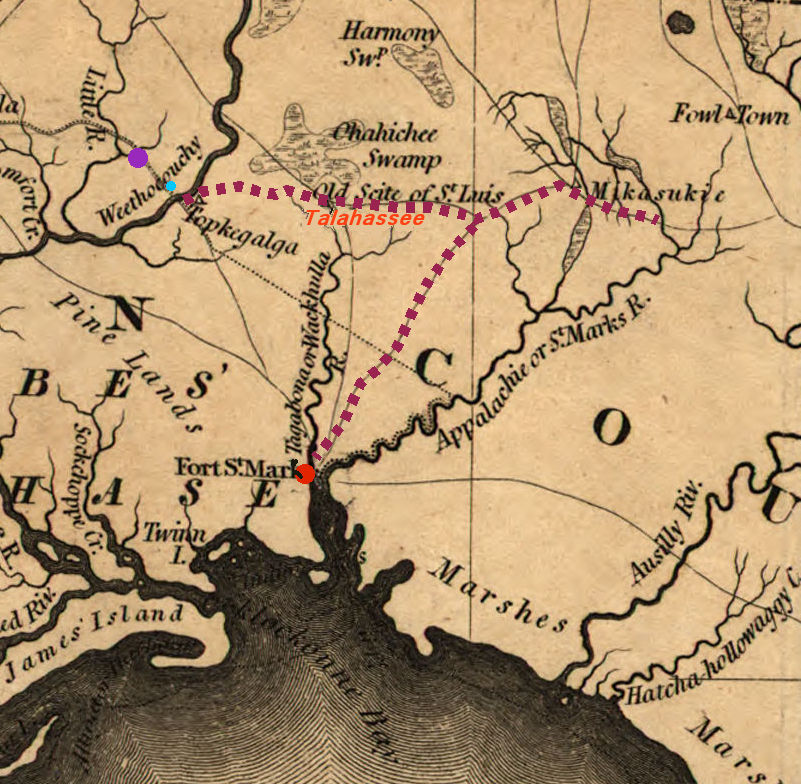
Simmons and Williams Route
Fortunately, Captain McClintock loaned Williams his horse and they set off the following afternoon with the goal of visiting the village of Tallahassee and gain favor of the local Indian chiefs. Meanwhile, Dr. Foster and Dr. Simmons’ black servant returned to Fort Marks to obtain provisions.
The following day they reached an Indian village where they were met by a “stout Indian in a nut patch” who they asked for information about where the chief was. The stout Indian responding by firmly demanding what they wanted, and said he was Neamathla, he was the chief. Simmons said that Neamathla and his people were much disturbed by their visit. After Simmons and Williams explained the purpose for their visit was to find a location where the governor and his council could meet, Neamathla wasn’t satisfied and insisted they stay the night so he could send for an interpreter to discuss it further.
That afternoon they watched the Indians play ball in the court in the village center. Williams described the game.
In the afternoon his young men and women played ball against each other with great spirit. Their ball ground is a large circle in which is placed a large pole; against this each party threw the ball; if caught on the rebound by the party who threw it, they tallied two. They were all naked to the waist and males and females exerted themselves with nearly equal energy. The women threw the ball with their hands, the men threw and caught it with their bat sticks. Many scuffles occurred between the parties to catch or prevent the ball from being caught, but all ended in perfect good humor. The men evidently gave the advantage to the females, who, in the end, won the
That evening a large council fire was built in the village square with the Indians singing all the while. Then the dances began, there was an intricate dance performed by the men in a line, then the rattlesnake dance in which if a dancer touched an upright cane planted in the ground while dancing around it that they would sure to be bitting by a rattlesnake on the first hunting trip. The wampum and mad dances followed in which the women wore rattles on their legs which the stomped together in perfect time. Williams grew tired and wrote that he fell asleep before it ended and when he awoke the square was deserted.
Simmons described the dancing as follows,
The Indians were dancing the snake dance, a superstitious and stated festivity, which was always held in this month. Its object is to lay the serpents. … country. In one of their dances called the "mad dance," most of their gestures and movements were highly martial and graceful and served to illustrate the natural elevation and fire of their character.
That night the slept under the thatched roof of the council house but “were disturbed a good part of the night through.”
Surviving the night with their scalps intact, the following morning Neamathla talked to them again with an interpreter and the stated their object in visiting the area. Neamathla, agreed to let them proceed, but told them they were not to tell any of the Indians that he had sent them and not to tell other Indians that he had given them permission to selected a site for the government seat. After paying Neamathla two dollars for taking care of their horses and for corn and potatoes, they set off reaching the old town of Tallahassee which had been burned to the ground by Andrew Jackson back in 1818. Williams described it with “huts are few in number, though the fields are extensive and covered with large peach trees.” Both Williams and Simmons tell of meeting chief Chifixico although Williams says little more, Simmons writes that chief Chifixico opposed them from proceeding and then, “angrily caught up a handful of dirt, and presenting it asked if that was not his land; he then mounted his horse and rode off to Neamathla's to inquire further into the objects of our visit.” At this point Simmons wrote, “From the behavior of this chief and other Indians whom we met, I am convinced these people will not be removed without difficulty.”
From the old settlement of Tallahassee, they proceed east arriving at the middle branch of the St. Marks River at 3 p.m. where they set up camp. While Dr. Foster’s servant stayed at camp, they continued on reaching the eastern branch of the St. Marks in about two miles. The point on the river they arrived there is a natural bridge where, like the Santa Fe River, the St. Marks goes underground for a quarter of a mile (in comparison, the Santa Fe goes underground for three miles). This place is now the Natural Bridge Battlefield Historic Florida State Park. From the Natural Bridge, the party split with Simmons and the guide going northward to trace the river, while Williams and Dr. Foster went south. After several hours both parties returned to the natural bridge and then returned to camp for the night.
The following day, October 30th, the returned westward exploring the area which the passed many scattered Indian villages before encamping for the evening on the deserted fields west of Tallahassee. The following day they met and Indian hunter who they paid a quarter of a dollar to guide them to an old Spanish Fort which they knew was in the area. Upon finding old fort they found the remains of the moat, parapet and bastions remaining along with two, old broken six-pound cannons. They returned to camp at 12’ o’clock where Williams fired their guide, “finding him worse than useless.” Williams, “gave him $10.00, but was sorry to observe that my colleagues parted from him with regret.” After dinner, Simmons traveled to old Tallahassee to visit a very old Indian who told him the about the capture and destruction of the old fort they had visited.
He informed the doctor that this country was formerly settled thick with Spanish villages; that the Yamasses, or bone tribe, were their allies, but the Muscogees were their enemies and finally conquered them; that he well remembered when they took the old fort, or rather when the Span- iards evacuated it in the night, after laying trains of pow- der to burst their cannon; that about the same time an old monastery was destroyed, at some distance from this place in an easterly direction, where a large bell is still to be seen. The Yamasses were nearly destroyed in that war.
After breaking camp the following day, they headed southward and after camping one night, arrived at Fort. St. Marks st 1 p.m. on November 1st. While Simmons made preparations for his return to St. Augustine, Williams and Dr. Foster made a five-day excursion to survey the St. Marks River in which they went upstream some distance before returning to the Fort St. Marks.
Updated: 2026-08-07