


A New Capital
Missing The Suwannee
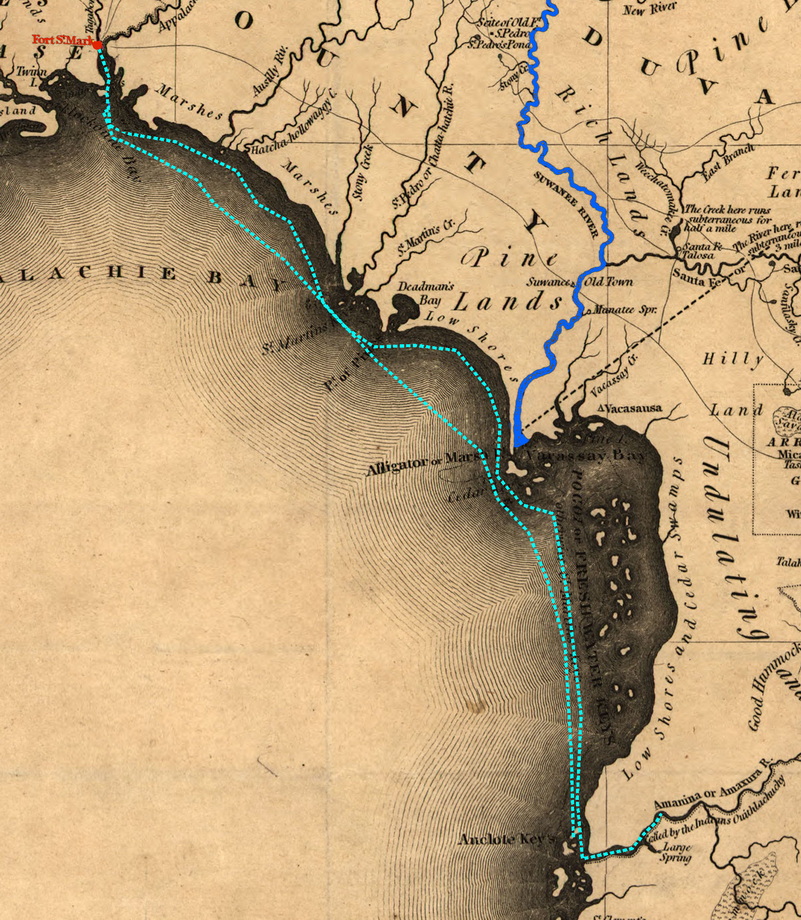
Simmons and Williams Route. Suwannee River in Blue
At this point Simmons thought their mission was completed but Simmons and Dr. Foster thought differently, thinking that the Suwanee River had all the “advantages of commerce” that the St. Marks had, they would not agree to the mission being completed until they examined it so on November 6th the Willams and Simmons along with two oarsmen embarked in a pirogue from the fort with the intent of going to the Suwanee. Reaching the bay, they turned eastward going along the coast some fifty miles reaching the Choctawhatchie River (labeled the “St. Pedro or Chattshatchie R.” on Vignoles 1832 map later became the Steinhatchee River) where they made camp on an island under cabbage and cedar.
The following morning, they sailed at 5 a.m. with “marshes along shore extend from three to five miles into the gulf, among which deep “among which deep bays and islets vary the prospect, beyond which the main shore rises, covered with thick woods beautifully marbled by a light frost into all the shades of autumn.” After passing several small islands, they came to a large river which Dr. Foster thought to be the Achinghatchie river so they passed it by and “encamped on a pleasant key near the shore of the grass marsh at sunset,” after traveling what he said was fifty miles.
Here is it clear that Williams and Simmons did not know exactly where they were. The first day he said they traveled 50 miles which is about the correct distance from St. Marks to the Steinhatchee River. From the Steinhatchee to the Suwanee is only about 30 miles so if they traveled another 50 miles it would have put them well past the Suwannee, so it is likely the river they thought was the Achinghatchie was actually the Suwannee.
On November 8th they set sail at 6 a.m. and after some time, having exhausted their fresh water, they approached shore when they ran aground on a shoal where they left one of the men with the boat and went in search of fresh water. Although not finding any water, Williams did discover, “a place where the savages had carried on an extensive manufacture of arrow and spear heads, from the fine nodules of flint bedded in the lime rock which had been washed out by the waves. Among the chips I picked out seven fine arrows, with two or three partly finished.” With the tide rising, the managed to get the boat afloat and continue their journey when late in the day they ran up a bayou five miles into the marshes where they found a “creek of cool sweet water,” and they camped the night. Ledgen ledgion
The following morning the pressed forward and at 10 o’clock entered the mount of an “extensive river, which poured a broad flood though several islets and keys.” Thinking they had reached the Suwanee, the proceeded up the channel about nine miles, “where it suddenly broke up into numerous islands and the whole of the channel became at once impassable from falls and rocks.” Williams said they, “were astonished by this unexpected impediment.” Indeed, the Suwanee was known to be navigable my smaller boats forty or more miles. After exploring upstream on foot they, “On a full consideration, we determined that this could not be the Suwannee.” After returning to their boat, they proceeded back to the mouth of the river where they camped for the night, “under a solitary cedar at the edge of the marsh.” It seem they found the Withlacoochee River (Amaxura or called by the Indians Ouithlachuchy river on Vignoles map).
On November 10th the rigged a large blanket for a sail and with a good breeze made good distance before camping on a pleasant key and made supper of fresh oysters from the bay. The following morning the set sail at 4 a.m. and reach Fort St. Marks before evening on November 11th.
On the 12th Williams was able to obtain passage on ship at St. Marks bound for Pensacola which he reached “with out any accident in three days.” He had been gone 45 days. Simmons did not record his return to St. Augustine so it is unclear if he went overland or by sea.
Simmons idea of the government seat being on the Suwannee River was never pursued any further. The Suwannee to this day remains in its mostly original natural state.
Updated: 2026-08-07