


A Bit of History
Moses Elias Levy
1823
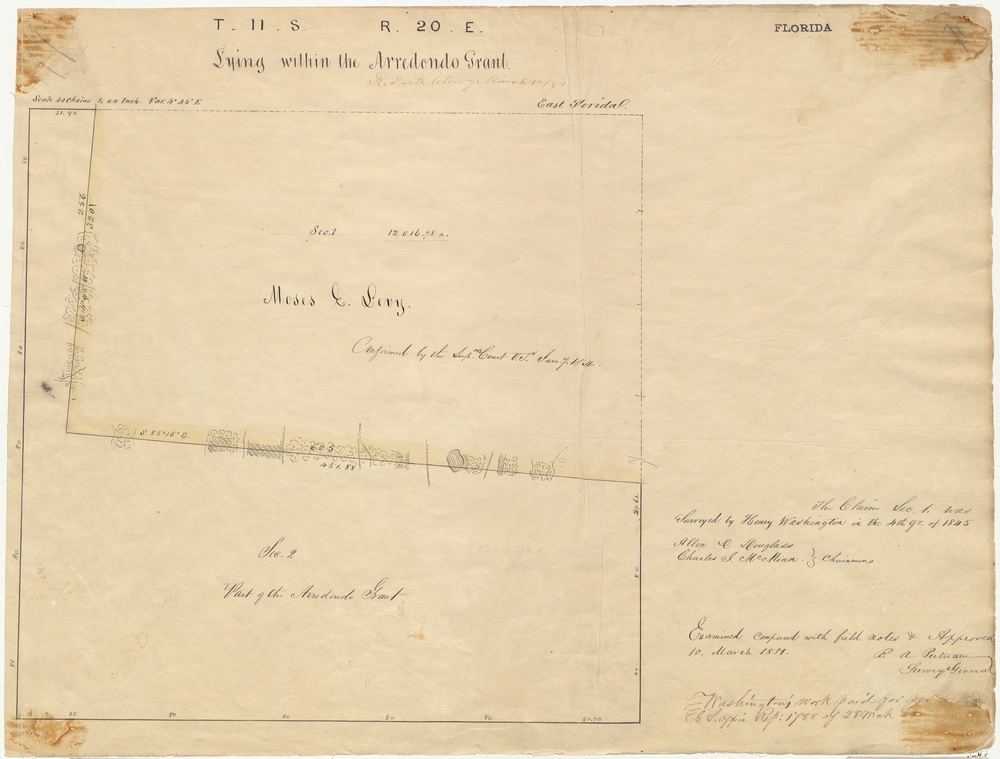
Moses Elias Levy’s 20,00 acres in the Arrendondo Grant
Alachua County, FL Records
Click to see expanded map
Moses Elias Levy was a most interesting character, born in Morocco in 1782, the son of a Sephardic Jewish official. After a period of anti-Semitism, the family fled the country to Gibraltar then to the West Indies where the family became wealthy. After seeing the plight of Jewish communities across Europe, Levy devised a plan to offer fellow Jews refuge in the United States. During a trip in 1816 to London to seek funding for his settlement he met Frederick Warburg, with whose funding, they became business partners and set sail to America to find suitable land.
At first Levy looked westward to the Illinois frontier, but with Spain ceding Florida to the United States in 1820, Levy changed the focus to Florida considering that they could transport families to Florida at a fraction of the cost of traveling hundreds of miles inland to Illinois. In March of 1820, Levy purchased 15,000 acres from Don Fernando de la Maza Arredondo. This acreage was not part of the contested Arredondo Grant in central Florida but rather was located on the Saint Johns River just South of Lake George and thus was not part of the land grant controversy. The same month Levy purchased an additional 52,900 acres dispersed throughout East Florida. At an average of 73 cents an acre, the land was a bargain.
In 1821 Levy traveled to New York to meet with prominent Jewish leaders to solicit support for his community which he described as a boarding school, or Chenuch, a Hebrew word that emphasized practical or vocational training. The Chenuch would have an educational focus which Hebrew youth would be taught, in addition to the Hebrew language, useful arts and science with attention given to student’s physical activity and health with emphasis on learning basic farming skills (for boys only). After completion of their schooling, the male students were be given land to start their own farms and families. A noble goal indeed.
Arriving on May 4, 1922 in St. Augustine, Moses Levy begin a full-scale effort to establish a plantation infrastructure on a 1,200 acre estate which he named Hope Hill. At this time Moses Levy obtained an additional 20,000-acre tract of land from Don Arrendondo in the Arrendondo Grant which ownership was still being contested in court. This made the tract of questionable value for if the court decided against Arrendondo’s right of ownership, then any land he sold to Levy would be in question. But the deal had a benefit to Arrendondo in that one of the stipulations of the grant was to have 200 families settled on it within three years and time was running out. If Moses Levy was successful with his creation and settlement of his Chenuch, it would bring the much-needed families. Levy named his new settlement Pilgrimage envisioning of the Jewish settlers to come.
Levy’s tract was centrally located in the Arrendondo grant and contained the southern portion of the great Alachua Savana which was ideal for raising cattle. Much of the land was covered with hardwood hammock providing need wood for building structures. The southwest corner of the tract rested on a large lake upon which he would build his settlement and is known today as Levy’s Lake. The lake not only provided ample fresh water but also provided a natural fertilizer from the plants floating on the lake. Just to the east of Levy’s track was the home of Wanton and the settlement of Micanopy which had trade routes eastward and westward. Situated in Levy’s track was a good-sized lake which was named Lake Warburg after Levy’s business partner. [see map]
At first Levy hired a man named Rutan to help build the new community but, fearful of the Native Indians, Rutan fled his post and sought safety in St. Augustine. With Rutan gone, Levy turned to the long-time settler and founder of Micanopy, Edward Wanton. In short order various dwelling houses, sugar mill, a sawmill, and a black shop were built. Much of the labor to construct Pilgrimage was done by slave labor, or more specifically, black Seminole “slaves”, which Levy provide items of trade to the Seminoles for their labor. Levy did have concerns, writing to Moses Myers, “Oh my good Sir! I have embarked myself in wild country peopled with wolves instead of men.”