


The Old Country
1841
David Levy
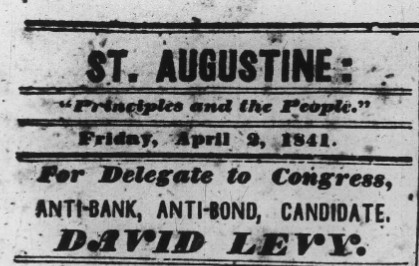
Florida Herald and Southern Democrat, April 2, 1841, p2
David Levy narrowly won the Florida Territorial Delegate to Congress over the second-place candidate by 457 votes. A celebratory Barbecue was given the following Saturday…
Was just what such things should be-a convivial assemblage where everyone was determined to be good humored and good natured. The table was abundantly supplied with ‘savory meats,’ well prepared-it was a ‘feast of fat things.’ Everyone enjoyed himself, and mothering occurred to mar the general harmony.
David Levy, Esq., attended, and addressed a large assembly of his constituents in a neat but brief address.
The company retired to their homes at a late hour, each one pleased with himself and his neighbor.
Florida Herald and Southern Democrat, 1841-06-11, p2
On June 21,1841 Levy appeared for the first time on the floor of the House of Representatives in Washington to present his credentials as the newly elected delegate. David Levy was the son of Moses Levy who was instrumental in the settlement of Alachua and Micanopy. David Levy had become estranged from his father in part due to Moses not approving of David’s entry into politics. Moses Levy’s sense of estrangement from his son was later eased by his reconciliation with David in 1845 when Moses said, “The resumption between us of our natural relations without any compromise in our respective views of duty and life.”
David Levy’s election was not without controversy. The question of Levy’s citizenship was raised by opponents and became an issue during David Levy’s campaign. The issue stimmed from David’s father, Moses Levy, not being present during the actual change-of-flags ceremony of the transfer of Florida to the U.S. by Spain which was the standard by which the inhabitants of Florida at the time were automatically awarded U.S. citizenship. In the end the courts ruled in favor of David Levy’s right of citizenship.
Not being a state, the Florida Territory was entitled to a single, nonvoting seat in the U.S. House of Representatives. Levy ran on the Democratic party ticket giving him a slight advantage as the Whig Party was at a disadvantage because the party ticket was split between two rivals. After the financial Panic of 1837 resulted in the failure of many banks, it created an opportunity for the “Anti-Bank, Anti-Bond” candidacy of David Levy. Despite a ruling from the Court of Appeals in Tallahassee which upheld David Levy’s U.S. citizenship, the issue continued to plague him, and the charge was renewed after his election.
Not only was Levy accused of being an “alien,” but there were efforts to excite antisemitic prejudices as well. In response, David Levy’s supporters reminded the electorate of their candidate’s personal struggle for religious choice: “With the unflinching fortitude of the proscribed race from which he sprung, he has suffered bitter persecution and disinheritance because he would and could not adhere to the religious dogmas of his ancestors.” Religion and family discord were used in the election process. Although David Levy won the election, the outcome was immediately contested. A petition to Congress asserted once more that Levy, as an alien, could not legally serve his term. A House committee was formed to examine the matter. Distinguished members of Congress, including John Quincy Adams, had made up their own minds regarding the controversy. Adams privately referred to David Levy as the “alien Jew Delegate” and also conjectured, albeit sarcastically, that, if Levy’s “dash of African blood” were proven, it would be “a far more formidable disqualification.” Moses Levy refuted all accusations in a series of articles in the Florida Herald and Southern Democrat which included documents from his days in Cuba as well as a letter written by Zephaniah Kingsley which “indignantly” denied that Levy’s sons “were of colored origin.”